
A virtual Chief Information Officer, or vCIO, is a fractional technology executive who delivers C-suite IT leadership to small and mid-sized businesses without the cost of a full-time hire. The role covers strategic planning, budget oversight, vendor management, and cybersecurity governance. Businesses with 10–200 employees that have outgrown ad-hoc IT support but cannot justify a six-figure executive salary are the primary candidates. Understanding what a vCIO does, how the role differs from a traditional CIO, and how to integrate one into your operations gives you a clear path to better IT decisions.
What is a vCIO and what does the role actually cover?
A vCIO is defined as a senior IT leader who works with your organization on a fractional basis, typically 10–20 hours per month, to align technology decisions with business goals. The “virtual” in vCIO describes the fractional engagement model, not purely remote work. A vCIO may meet with your leadership team in person, attend board meetings, and participate in vendor negotiations. The role is about strategic ownership, not physical location.
The core deliverable is a technology roadmap reviewed and updated quarterly to keep IT investments aligned with where your business is headed. That roadmap drives every other decision, from which software platforms to adopt to when to refresh aging infrastructure. Without it, technology spending tends to be reactive and fragmented.

A vCIO also manages IT budgets and vendor contracts, oversees cybersecurity and compliance planning, and provides on-call availability for strategic escalations. The engagement cadence typically includes quarterly business reviews and monthly or weekly strategy meetings, depending on the complexity of your environment. This structured rhythm is what separates a vCIO from a one-time IT consultant.
Key vCIO responsibilities at a glance
- Technology roadmap development: Builds and maintains a multi-year IT plan tied to your revenue and growth targets.
- Budget and vendor management: Negotiates contracts, eliminates redundant tools, and keeps IT spending predictable.
- Cybersecurity and compliance oversight: Coordinates risk assessments, policy reviews, and regulatory readiness. A virtual CISO function often sits within or alongside this responsibility.
- Quarterly business reviews (QBRs): Delivers structured updates on IT performance, risk posture, and upcoming investments.
- Strategic escalation support: Available when a major vendor decision, security incident, or board presentation requires executive-level IT input.
Pro Tip: Ask any prospective vCIO to show you a sample technology roadmap from a previous engagement. The quality of that document tells you more about their strategic thinking than any sales conversation.
How does a vCIO differ from a full-time CIO or IT consultant?
The difference between a vCIO and a full-time CIO is primarily scope and cost. A full-time CIO commands a salary that most small and mid-sized businesses cannot sustain. A vCIO delivers executive-level IT leadership at a fraction of that cost, making strategic guidance accessible to organizations that previously had no seat at the C-suite table for technology.
An IT consultant, by contrast, is typically project-based. You hire a consultant to evaluate your network, implement a new system, or audit your security posture. The engagement ends when the project closes. A vCIO maintains an ongoing strategic partnership, building institutional knowledge about your business over time and adjusting the IT plan as your goals evolve.
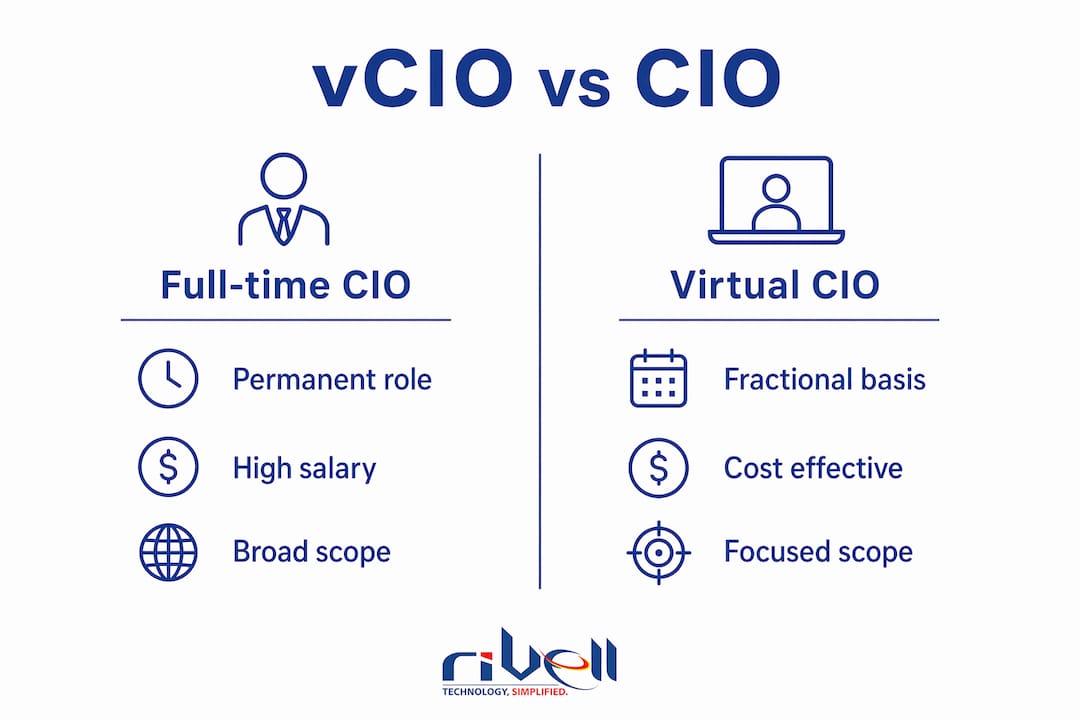
The distinction from an IT manager or managed service provider (MSP) is equally important. An IT manager handles day-to-day execution while the vCIO focuses on connecting IT investments to long-term business objectives such as revenue growth and risk mitigation. Many MSPs include a vCIO layer above their operational support, positioning it as the strategic function that directs where the operational team focuses its effort.
| Role | Engagement type | Primary focus | Typical cost model |
|---|---|---|---|
| Full-time CIO | Permanent employee | Enterprise-wide IT leadership | Annual salary plus benefits |
| vCIO | Fractional, ongoing | Strategic IT alignment for SMBs | Monthly retainer |
| IT consultant | Project-based | Specific deliverable or audit | Hourly or fixed project fee |
| IT manager | Operational employee | Day-to-day IT execution | Annual salary |
| MSP | Ongoing operational | Reactive and proactive support | Per-user or per-device fee |
A common misconception is that a vCIO simply replaces your help desk or MSP. It does not. The vCIO sits above operational IT, directing strategy while your support team handles execution. Blending these two functions is one of the most frequent mistakes organizations make, and it dilutes the strategic value the vCIO is supposed to deliver.
What are the benefits of hiring a vCIO for small and mid-sized businesses?
The most direct benefit is access to C-suite IT thinking without the full-time salary. A vCIO gives your leadership team a technology peer who speaks the language of business outcomes, not just infrastructure specs. That changes how IT gets discussed at the board level and how budgets get approved.
Board-level visibility into IT risks and expenditures is a specific advantage that many SMBs lack entirely. Without it, organizations accumulate technical debt that limits their ability to scale over a three-to-five-year horizon. A vCIO surfaces those risks before they become expensive problems.
The financial case is also clear. A vCIO helps businesses prevent costly technology mistakes by aligning IT investments with operational goals and providing continuous risk management. Overspending on tools that duplicate each other, under-investing in security, and signing unfavorable vendor contracts are all patterns a vCIO identifies and corrects.
Additional benefits include:
- Cybersecurity posture improvement: A vCIO coordinates risk assessments and compliance readiness, reducing exposure to breaches and regulatory penalties. Understanding cybersecurity fundamentals is part of what a vCIO brings to your leadership team.
- Vendor negotiation leverage: A vCIO knows market rates and contract terms, which translates directly into savings on software and service agreements.
- IT strategy tied to growth: Technology investments get planned around your hiring timeline, market expansion, and product roadmap, not just current pain points.
- Reduced decision fatigue for executives: Business owners stop fielding every IT question and instead receive clear recommendations with business context attached.
How to integrate a vCIO into your existing IT operations effectively
Integration works best when roles are defined before the engagement starts. The vCIO owns strategy. Your internal IT staff or MSP owns execution. Confusion about that boundary is the most common reason vCIO engagements underperform.
A structured onboarding process sets the foundation. Follow these steps to get the most from a vCIO relationship from day one:
- Conduct a baseline IT assessment. The vCIO needs a clear picture of your current infrastructure, vendor contracts, security posture, and IT spending before building any plan.
- Define the communication cadence. Agree on the frequency of QBRs, monthly strategy calls, and escalation protocols before work begins.
- Separate strategic and operational responsibilities in writing. Document which decisions require vCIO sign-off and which the MSP or IT manager handles independently.
- Set measurable goals for the first 90 days. Examples include completing a vendor contract audit, delivering a three-year technology roadmap, or achieving a specific compliance benchmark.
- Review outcomes at each QBR. Use the quarterly business review structure to measure progress against goals and adjust priorities as your business changes.
Pro Tip: If your vCIO is also your MSP’s account manager, push back. That dual role creates a conflict of interest. Strategic advice should never be influenced by which services generate the most revenue for the provider.
A vCIO should not be the routine help desk escalation point. Operational incidents should follow documented IT support tiers and escalation rules, while the vCIO focuses on business-impact decisions, budgets, risk, vendors, and technology direction. The division can be adapted within co-managed IT services when internal and external teams share ownership.
Key Takeaways
A vCIO delivers strategic IT leadership on a fractional basis, giving small and mid-sized businesses C-suite technology guidance without the cost of a full-time executive hire.
| Point | Details |
|---|---|
| vCIO definition | A fractional IT executive who aligns technology decisions with business goals on an ongoing basis. |
| Cost advantage | A vCIO provides executive-level guidance at a fraction of a full-time CIO’s salary and benefits. |
| Strategic vs. operational | The vCIO directs IT strategy; your MSP or IT manager handles day-to-day execution. |
| Engagement structure | Quarterly business reviews and monthly strategy meetings keep the plan aligned with business priorities. |
| Primary risk benefit | Board-level visibility into IT spending prevents technical debt that limits growth over three to five years. |
Why most SMBs get IT leadership backwards
The businesses I see struggle most with technology are not the ones with bad IT support. They are the ones with no one connecting IT decisions to business outcomes. Their MSP keeps the lights on, their internal staff handles tickets, and no one is asking whether the technology stack actually supports where the company is going in three years.
That gap is exactly what a vCIO fills. But here is the part most articles skip: the value of a vCIO depends almost entirely on whether the business owner treats them as a peer or as a vendor. When a vCIO gets a seat at the leadership table, attends strategic planning sessions, and has visibility into revenue goals and hiring plans, the technology roadmap they build is genuinely useful. When they are kept at arm’s length and handed a list of IT problems to solve, they become an expensive consultant.
I also think the platform-agnostic standard matters more than most buyers realize. A vCIO who is tied to specific technology vendors will always have a subtle bias toward recommending those products. The right vCIO evaluates tools based on your business requirements, not their partner margins. Ask directly: “Do you receive referral fees or commissions from any vendors you recommend?” The answer tells you a great deal about the advice you will receive.
The future of IT leadership for SMBs points toward this fractional model becoming the norm rather than the exception. The cost of full-time executive talent keeps rising. The complexity of cybersecurity, compliance, and cloud infrastructure keeps growing. A well-structured vCIO engagement gives smaller businesses the same quality of IT thinking that enterprise companies have always had access to. That is not a small thing.
— Ryan
Strategic IT leadership is part of what Rivell delivers
Rivell provides managed IT services for small businesses that go beyond reactive support. For New Jersey businesses that need both operational reliability and strategic IT direction, Rivell’s approach includes the kind of technology planning, vendor oversight, and cybersecurity alignment that a vCIO engagement delivers.
With over 25 years of experience managing IT environments across healthcare, professional services, and other industries, Rivell takes full ownership of your technology so your team can focus on running the business. If you want IT decisions that connect to your growth goals, explore the benefits of managed IT services Rivell offers and find out what the right level of IT leadership looks like for your organization.
FAQ
What does vCIO stand for?
vCIO stands for virtual Chief Information Officer. It describes a fractional IT executive who provides strategic technology leadership to businesses that do not employ a full-time CIO.
How much does a vCIO cost compared to a full-time CIO?
A vCIO typically costs a fraction of a full-time CIO’s salary, making executive-level IT guidance affordable for small and mid-sized businesses with 10–200 employees.
Is a vCIO the same as an IT manager or MSP?
No. An IT manager and MSP handle day-to-day operations and reactive support, while a vCIO focuses on connecting IT investments to long-term business goals such as revenue growth and risk mitigation.
How often does a vCIO meet with your team?
A typical vCIO engagement includes quarterly business reviews, monthly strategy meetings, and on-call availability for strategic escalations, totaling roughly 10–20 hours per month.
What is the difference between a vCIO and a virtual CISO?
A vCIO oversees the full IT strategy including budgets, vendors, and technology planning. A virtual CISO focuses specifically on cybersecurity leadership, risk management, and compliance. The two roles are complementary and often work together in mid-sized organizations.