
Endpoint protection is defined as a proactive cybersecurity layer that monitors every device connected to your corporate network, detecting and automatically responding to threats that traditional antivirus cannot catch. Every laptop, smartphone, server, and remote workstation is a potential entry point for ransomware, fileless malware, and zero-day exploits. Regulations like HIPAA, GDPR, PCI DSS, and SOC 2 now require documented endpoint controls as part of compliance audits. For any business serious about its cybersecurity strategy, endpoint protection is not optional. It is the foundation.
How does endpoint protection differ from traditional antivirus?
Legacy antivirus is a reactive tool. It compares files against a database of known malware signatures and flags matches. That approach fails completely against zero-day attacks and fileless malware, which leave no file to scan. Endpoint protection continuously monitors behavior across every corporate device, regardless of location, and automates remediation when it detects suspicious activity.
Endpoint protection, backup, and remote monitoring solve different problems. A centralized endpoint-security console can improve visibility across office, remote, server, and cloud workloads, but it does not by itself provide recoverable backups or an RMM operating process. Teams replacing a Datto component should use this Datto alternatives guide to map backup, BCDR, RMM, SaaS protection, and service ownership separately before comparing products.

The detection method is also fundamentally different. Lightweight endpoint agents perform behavioral telemetry at the kernel level, watching how processes behave rather than what files look like. This catches fileless attacks that inject malicious code directly into memory, leaving nothing for a signature scanner to find.
| Feature | Legacy antivirus | Modern endpoint protection |
|---|---|---|
| Detection method | Signature-based file scanning | AI behavioral analysis at kernel level |
| Threat coverage | Known malware only | Zero-day, fileless, ransomware, insider threats |
| Device scope | Single device | All network-connected endpoints |
| Response | Manual quarantine | Automated isolation and remediation |
| Compliance support | None | HIPAA, GDPR, PCI DSS, SOC 2 enforcement |
| Performance impact | High during full scans | Minimal, AI-optimized resource usage |
The table above shows why businesses replacing legacy antivirus with endpoint protection gain both stronger security and better day-to-day performance.
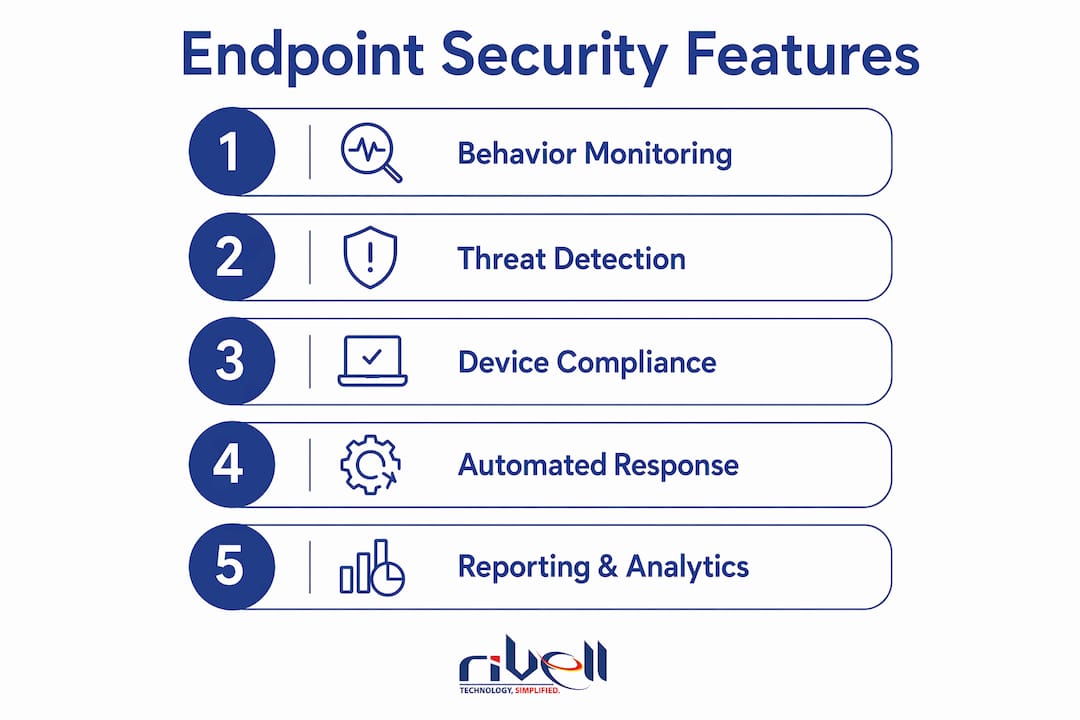
What features does comprehensive endpoint security require?
The most effective endpoint security solutions share a core set of capabilities that go well beyond virus scanning. Each feature addresses a specific gap that attackers actively exploit.
- AI-driven behavioral monitoring. The platform watches process behavior in real time, flagging anomalies like a spreadsheet application attempting to access system files or a user account logging in from two countries simultaneously.
- Automated isolation and remediation. When a threat is confirmed, AI-driven solutions reduce response times from hours to seconds by isolating the affected device and rolling back malicious changes without waiting for human approval.
- Compliance policy enforcement. The platform verifies that every device meets OS patch levels, password policies, and disk encryption requirements before granting network access. This directly supports HIPAA and PCI DSS audit requirements.
- Integration with IAM and MDM. Endpoint protection achieves maximum effectiveness when combined with Identity and Access Management systems like Microsoft Intune or Okta, creating a unified compliance checkpoint at every login.
- Centralized dashboard. Security teams need a single view showing device health, threat status, and compliance posture across every endpoint. Without it, gaps go unnoticed until a breach occurs.
- Remote and hybrid workforce coverage. Endpoints off the corporate network are just as exposed as those on it. Cloud-delivered protection extends the same policies to home offices and traveling employees without requiring a VPN connection.
Pro Tip: Start with monitoring-only mode for the first two to four weeks after deployment. This gives your team time to identify business-critical applications that need whitelisting before you enable blocking policies, preventing productivity disruptions on day one.
Businesses in regulated industries like healthcare should also review HIPAA compliance requirements alongside their endpoint feature checklist, since specific controls around encryption and access logging are mandatory, not optional.
How do businesses implement endpoint protection effectively?
Deployment done poorly creates as many problems as it solves. False positives block legitimate work, frustrated employees find workarounds, and security gaps reopen. A structured rollout prevents all three outcomes.
- Deploy agents in learning mode first. Initial deployment uses a learning phase to map normal application behavior across your environment. The platform builds a baseline before it starts making blocking decisions.
- Whitelist proprietary and business-critical applications. Custom software, legacy line-of-business apps, and specialized tools often trigger behavioral alerts. Identify and whitelist these during the learning phase so they never interrupt operations.
- Automate compliance checks from day one. Configure the platform to verify disk encryption, OS patch status, and password policy compliance on every device at every login. Non-compliant devices get quarantined automatically until they meet policy.
- Connect cloud-based threat intelligence. Cloud-delivered telemetry pulls threat data from millions of endpoints globally, updating detection models in near real time. This is how your platform learns about a new ransomware variant within hours of its first appearance anywhere in the world.
- Shift from alert triage to threat hunting. Security teams must move beyond reactive alert responses to proactive threat hunting, actively searching for indicators of compromise before an attack completes. This requires dedicated time and trained analysts, not just a dashboard.
Pro Tip: Use your endpoint platform’s reporting to generate a monthly compliance scorecard. Share it with department heads so they understand which teams have the most unpatched devices or policy violations. Visibility at the management level drives faster remediation than IT tickets alone.
Understanding the common network security threats your business faces helps you prioritize which endpoint policies to enforce first, since not every organization carries the same risk profile.
Why is endpoint protection central to your cybersecurity strategy?
Endpoint protection does not operate in isolation. It is the device-level enforcement layer that makes your broader security architecture function. Network firewalls stop threats at the perimeter. Endpoint protection stops threats that are already inside, whether through phishing, compromised credentials, or a malicious USB drive.
The compliance argument is equally direct. Endpoint security enforces compliance policies by verifying OS versions, password rules, and encryption status, then blocking non-compliant devices from accessing corporate resources in real time. That automated enforcement is what auditors for HIPAA, GDPR, and SOC 2 want to see documented.
Ransomware prevention is where endpoint protection proves its value most visibly. Ransomware attacks typically move laterally across a network for days before encrypting files. An endpoint platform running behavioral analysis detects that lateral movement early, isolates the affected machine, and stops the spread before it becomes a business-stopping event. The cost difference between early detection and a full ransomware recovery is measured in hundreds of thousands of dollars.
Insider threats are harder to catch but equally dangerous. Behavioral baselines make it possible to flag when an employee account suddenly downloads ten times its normal data volume or accesses files outside its usual scope. That anomaly triggers an alert or an automatic access restriction, giving your team time to investigate before data leaves the building.
Endpoint protection also supports forensic investigations. When an incident does occur, the platform’s telemetry provides a detailed timeline of every process, connection, and file change on the affected device. That log is what incident response teams use to determine the scope of a breach and what regulators require to close a compliance investigation. Reviewing network attack prevention tips alongside your endpoint strategy gives you a layered defense that covers both perimeter and device-level risks.
Key Takeaways
Endpoint protection is the device-level security layer that stops advanced threats, enforces compliance, and provides the forensic visibility that modern business cybersecurity strategy requires.
| Point | Details |
|---|---|
| Beyond antivirus | Endpoint protection uses AI behavioral analysis to catch zero-day and fileless threats that signature scanning misses. |
| Compliance enforcement | Platforms automatically verify encryption, OS patches, and password policies to meet HIPAA, GDPR, and PCI DSS requirements. |
| Structured deployment | Start in learning mode, whitelist critical apps, then enable blocking policies to avoid false positives and workflow disruptions. |
| Threat hunting over alert triage | Active threat hunting finds attacks in progress before they complete, reducing breach impact significantly. |
| Integration multiplies protection | Combining endpoint protection with IAM and MDM creates a unified compliance checkpoint at every device login. |
What I’ve learned after watching businesses get this wrong
Most businesses I talk to treat endpoint protection as a checkbox. They buy a platform, deploy it across their devices, and assume the work is done. That assumption is exactly what attackers count on.
The shift from legacy antivirus to AI-driven endpoint security is not just a technology upgrade. It requires a change in how your security team operates. Reactive alert triage is not enough. Endpoint security must be a continuous effort involving threat hunting and active monitoring, not a set-it-and-forget-it tool. The businesses that get breached are almost always the ones that stopped paying attention after deployment.
The compliance integration piece also gets underestimated. I have seen organizations pass their HIPAA audit with a well-configured endpoint platform and fail the next one because no one updated the policies after a major software rollout. Endpoint protection requires ongoing policy management, not just initial configuration.
My honest recommendation: treat your endpoint platform as a living system. Review policies quarterly, run threat hunting exercises monthly, and connect your endpoint data to your broader incident response plan. The businesses that do this consistently are the ones that catch threats early, contain breaches fast, and satisfy auditors without scrambling.
— Ryan
How Rivell protects your business endpoints around the clock
Rivell brings over 25 years of managed IT experience to businesses across New Jersey, with endpoint protection built into every service package as a core component, not an add-on.
Rivell takes full ownership of your IT environment, which means continuous monitoring, automated threat response, and compliance enforcement run 24/7 without requiring your internal team to manage it. For small and medium businesses that need managed IT services without the overhead of an in-house security team, Rivell delivers expert-level endpoint protection, compliance support, and fast incident response. If your current setup relies on legacy antivirus or lacks centralized endpoint visibility, Rivell’s team is ready to close those gaps.
FAQ
What is endpoint protection in a business context?
Endpoint protection is a proactive cybersecurity layer that monitors all network-connected devices, detecting and automatically responding to threats like ransomware and fileless malware. It covers every laptop, server, and mobile device your employees use, on-site or remote.
How does endpoint protection support HIPAA and GDPR compliance?
Endpoint security platforms verify OS patch levels, disk encryption, and password policies on every device, blocking non-compliant devices from network access in real time. This automated enforcement directly satisfies controls required by HIPAA, GDPR, PCI DSS, and SOC 2.
Can endpoint protection replace a firewall?
Endpoint protection and firewalls address different attack surfaces and work best together. Firewalls filter traffic at the network perimeter, while endpoint protection stops threats that have already reached individual devices, including insider threats and phishing-delivered malware.
What is the biggest mistake businesses make when deploying endpoint protection?
Skipping the learning phase is the most common deployment error. Enabling blocking policies before whitelisting business-critical applications causes false positives that disrupt operations and push employees to disable protections entirely.
How often should businesses review their endpoint security policies?
Endpoint security policies should be reviewed at least quarterly, and immediately after any major software rollout, workforce change, or regulatory update. Continuous monitoring paired with scheduled policy reviews keeps protection current as your environment evolves.