
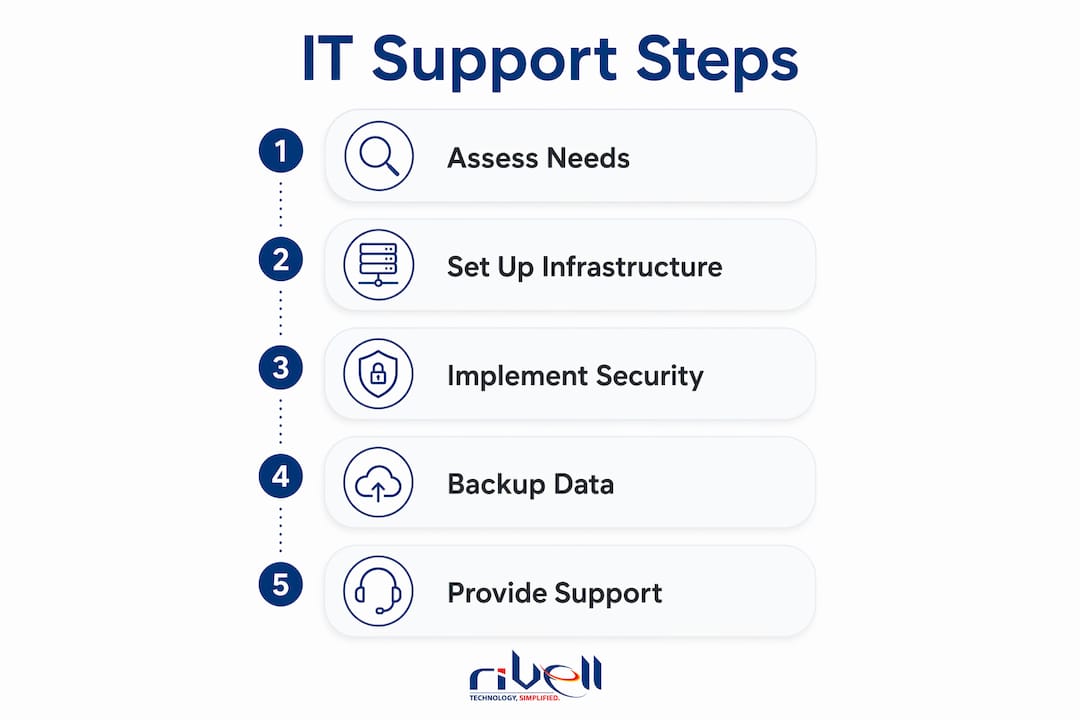
Computer support for business is the ongoing management, protection, and optimization of your company’s technology infrastructure, handled by professionals so your team can focus on actual work. It covers everything from a help desk technician resetting a locked account to a security engineer monitoring your network at 2 AM for ransomware activity. The core service categories include:
- Managed IT services — proactive, subscription-based monitoring and maintenance of your entire IT environment
- Co-managed IT — a collaborative model where an external provider supplements your existing internal IT staff
- Cybersecurity solutions — endpoint protection, firewall management, MFA enforcement, and security awareness training
- Data backup and disaster recovery — automated backups with tested restore procedures and defined recovery objectives
- Cloud services — Microsoft 365 administration, cloud migration, and SaaS platform management
- IT help desk — frontline support for employees dealing with software errors, connectivity issues, and device problems
Rivell LLC has delivered these services to New Jersey businesses for over 25 years, taking full ownership of clients’ IT environments so organizations can stop firefighting and start growing. The foundation of that model is proactive management and continuous monitoring, which catches problems before they become outages.
Table of Contents
- What computer support for business actually includes
- Why professional IT support pays off for small businesses
- Why outsourcing IT support makes sense for small businesses
- Rivell brings 25 years of IT expertise to New Jersey businesses
- Key Takeaways
What computer support for business actually includes
Help desk and end-user support
This is the frontline: the team employees contact for password resets, email configuration, VPN access, printer failures, and application crashes. For a Windows tunnel failure, a documented VPN Error 809 troubleshooting process should distinguish client, local-network, firewall, NAT, provider-path, and gateway ownership. Define severity, response, restoration, resolution, escalation, and coverage commitments in the service-level agreement before signing.

Infrastructure and network management
Behind every reliable business operation sits a well-maintained network. This layer covers server monitoring, patch management, hardware lifecycle planning, and cloud platform administration. For regulated industries like healthcare and law, it also means keeping infrastructure aligned with compliance requirements such as HIPAA and applicable FTC guidance.

Cybersecurity protection
The NIST Cybersecurity Framework (CSF 2.0) organizes security work into six practical functions: Govern, Identify, Protect, Detect, Respond, and Recover. The FTC highlights it as free, flexible guidance suited to businesses of any size. The U.S. SBA also recommends firewalls, MFA, and vulnerability scans as baseline controls, with free resources from CISA available to small businesses that lack dedicated security staff.
A critical gap many small businesses carry is that over 80% of business email compromise attacks succeed through accounts without multi-factor authentication, yet fewer than half of small and mid-sized businesses have MFA deployed. That is a fixable problem, and a competent IT support provider fixes it in the first 30 days.
Data backup and disaster recovery
Backups that have never been tested are not backups. They are guesses. Defining your recovery time objective (RTO) and recovery point objective (RPO) before a crisis determines how quickly your business can resume operations after a failure and how much data loss is acceptable. Tier your workloads by business impact, assign recovery priorities accordingly, and confirm your provider tests restores on a documented schedule.
Pricing models at a glance
Managed IT services are subscription-based and proactive; break-fix is pay-as-you-go and reactive. The cost difference is real. Managed IT typically runs $100–$200 per user per month nationally, while in-house IT staff generally cost more when salary, benefits, and tooling are factored in.
| Service model | Typical cost | Best for |
|---|---|---|
| Break-fix / hourly | — | Micro-businesses with minimal IT needs |
| Per-user managed IT | $100–$200/user/month | Growing teams needing predictable costs |
| Per-device managed IT | $30–$100/device/month | Device-heavy environments (retail, warehousing) |
| Co-managed IT | — | Businesses with partial in-house IT staff |
| Fully outsourced (flat fee) | — | SMBs wanting a complete virtual IT department |
One number to watch: out-of-scope costs commonly add 30%–50% to managed IT invoices, particularly for security add-ons, after-hours support, and project work. Get the exclusion list in writing before you compare quotes.
Why professional IT support pays off for small businesses
The clearest benefit is reduced downtime. When a provider monitors your systems around the clock, problems get caught before employees notice them. That shift from reactive to proactive is where most of the financial value lives.
- Predictable budgeting — a flat monthly fee replaces unpredictable repair bills
- Improved security posture — layered defenses including EDR, MFA, and patch management close the gaps attackers exploit
- Regulatory compliance support — for healthcare, legal, and financial services firms, an IT partner helps maintain the controls required by HIPAA, PCI-DSS, and similar frameworks
- Expert access — a managed IT team brings specialists in networking, security, and cloud that no single in-house hire can replicate
- Business continuity readiness — tested backup and disaster recovery planning means a ransomware attack or hardware failure does not end your week
Regulated environments require more than a one-time compliance checklist. They need ongoing risk assessments, accountable owners, and operational controls that get reviewed and updated. That is a program, not a project, and it is exactly what a professional IT support partner is structured to deliver.
Pro Tip: Ask any prospective IT provider to show you a documented restore test from the past 90 days. If they cannot produce one, their backup guarantee is theoretical.
Productivity gains are harder to quantify but just as real. When employees are not troubleshooting their own connectivity issues or waiting hours for a technician callback, they work. The cybersecurity tips for small businesses that matter most are the ones already built into a managed service agreement, not the ones on a checklist nobody reads.
Why outsourcing IT support makes sense for small businesses
Running IT in-house sounds appealing until you price it honestly. A single IT generalist costs $60,000–$90,000 per year in salary alone, covers only business hours, and carries one person’s depth of knowledge. When that person is sick, on vacation, or quits, your coverage disappears.
Outsourced IT support addresses all three problems at once. A managed service provider brings a full team, 24/7 monitoring, and specialists across networking, security, and cloud, at a monthly cost that scales with your headcount rather than your hiring timeline.
Choosing the right model
The break-fix vs. managed IT decision comes down to risk tolerance and operational reality. Break-fix works for a five-person shop running cloud-based apps where a down day is an inconvenience. Once you cross 10 employees, hold regulated data, or process payments, the math shifts decisively toward managed services. Co-managed IT is the right call when you already have an internal IT person who needs backup coverage, specialized security expertise, or help desk overflow support.
What to look for in a provider
Evaluating IT support providers requires going beyond price. The criteria that actually predict service quality:
- Scope clarity — what is explicitly included, and what triggers an extra bill
- Security inclusion — EDR, MFA, and monitoring should be standard, not upsells
- SLA specifics — look for mean time to resolution and system availability metrics, not just response time windows
- Process documentation — a provider who cannot show you their onboarding and escalation procedures is improvising
- Named account management — you need a specific person responsible for your environment, not a rotating help desk queue
- Contract governance — clear escalation paths and routinely reviewed performance metrics are what separate accountable providers from ones who coast
Good IT often feels invisible. When systems run well, there is no chaos to notice. The providers worth hiring are the ones preventing problems you never realize existed, and the way to identify them is through documentation, process rigor, and the quality of their answers when you ask hard questions.
For website security best practices that complement your managed IT coverage, the SBA-aligned guidance from CISA is a practical starting point for any small business.
Rivell brings 25 years of IT expertise to New Jersey businesses
Most IT problems that hurt small businesses are not exotic. They are preventable: unpatched systems, untested backups, missing MFA, no one watching the network after 5 PM. Rivell’s managed IT services for small businesses are built around fixing exactly those gaps before they become incidents.
With over 25 years of experience serving New Jersey businesses across healthcare, professional services, and other regulated industries, Rivell takes full ownership of your IT environment. That means continuous monitoring, help desk support, network and server management, cybersecurity protection, Microsoft 365 administration, cloud management, data backup, disaster recovery, and VoIP, all under one agreement with no surprise add-on bills for the security stack.
The model is straightforward: Rivell handles the technology, you run the business. Contact Rivell today to get a clear picture of what your IT environment needs and what it will cost.
Key Takeaways
Professional computer support for business requires proactive monitoring, tested backup and recovery, and security built into the base agreement, not sold as an add-on.
| Point | Details |
|---|---|
| Proactive beats reactive | Managed IT catches issues before they cause downtime; break-fix only responds after damage is done. |
| Security must be included | EDR, MFA, and 24/7 monitoring should be standard, not upsells; hidden add-ons add 30%–50% to invoices. |
| Pricing varies by model | Per-user managed IT runs $100–$200/user/month nationally; always compare all-in annual costs, not headline rates. |
| Recovery objectives matter | Define RTO and RPO before a crisis to confirm your provider’s backup plan matches your actual business needs. |
| Rivell for New Jersey businesses | Rivell delivers fully managed IT with 25+ years of experience, covering security, compliance, and recovery under one agreement. |