
Cloud management services are outsourced operational solutions where a third-party provider assumes day-to-day responsibility for your cloud infrastructure’s performance, security, and cost efficiency. Rather than leaving your internal team to juggle patching, monitoring, and compliance on top of everything else, a Managed Cloud Service Provider (MCSP) handles those functions under a defined service-level agreement. The result is a shift from unpredictable capital expenditure to a predictable operating expense model, with uptime guarantees and clear escalation paths baked in.
What does that operational handoff actually cover? At minimum, expect these core responsibilities:
- Continuous monitoring of compute, storage, and network resources across your environment
- Security management including threat detection, identity and access controls, and vulnerability patching
- Performance optimization through rightsizing, auto-scaling configuration, and workload tuning
- Incident response with defined SLAs for detection, notification, and resolution
- Compliance enforcement covering audit logging, policy controls, and regulatory reporting
- Cost governance via FinOps practices, spend alerts, and resource lifecycle management
- Backup and disaster recovery planning, testing, and execution
These services apply across public cloud platforms like AWS, Microsoft Azure, and Google Cloud Platform, as well as private clouds, hybrid environments, and multi-cloud architectures. The common thread is that the MCSP takes on the operational burden so your team can focus on strategy rather than firefighting.
Table of Contents
- How cloud management services actually work day to day
- What types of cloud services get managed, and how
- Why organizations adopt cloud management services
- Common challenges that make cloud management harder than it looks
- How Rivell delivers expert cloud management with 25+ years of experience
- Rivell is the cloud management partner built for New Jersey businesses
- Key Takeaways
How cloud management services actually work day to day
The operational model behind managed cloud solutions is a continuous lifecycle, not a one-time setup. Think of it in three phases: onboarding and configuration, ongoing management, and continuous optimization.
During onboarding, the provider assesses your existing environment, documents dependencies, establishes baseline performance metrics, and configures monitoring and alerting. Infrastructure as Code (IaC) tools like Terraform or AWS CloudFormation are typically used to standardize provisioning so environments are reproducible and auditable from day one.
Ongoing cloud management can include monitoring, alert response, access administration, capacity planning, and a documented software update and patching process. Responsibilities, maintenance windows, emergency changes, verification, and client notification should be defined by the service agreement.
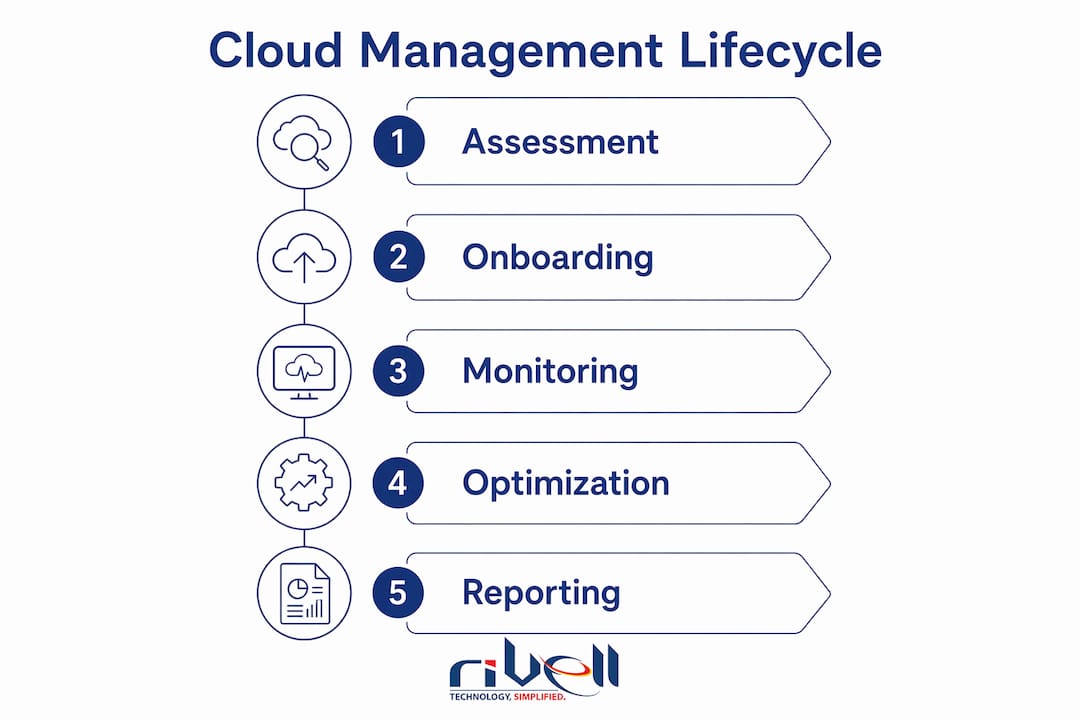
The optimization phase is often underestimated. Managed cloud providers continuously review cost allocation, identify idle resources, and recommend architectural changes to improve efficiency post-migration. Governance frameworks enforce consistent policies across workloads, and automation reduces the manual effort required to maintain compliance.
A few structural elements define how responsibilities are divided:
- Shared responsibility model: The MCSP handles operational excellence; the client defines business policies, data classification, and cloud strategy. IBM’s research on managed cloud governance highlights that a Cloud Center of Excellence within the organization helps keep cloud environments aligned with evolving business goals.
- Fully managed vs. co-managed: Fully managed shifts all operations to the provider. Co-managed IT arrangements split responsibilities, which requires precise contract language to avoid accountability gaps.
- Service contracts: These define scope, SLA tiers, response times, escalation procedures, and security responsibilities. Vague contracts are where most co-managed relationships break down.
Pro Tip: Before signing any managed cloud contract, map every operational task in your current environment and confirm explicitly which party owns each one. Gaps in that map become gaps in your coverage.
What types of cloud services get managed, and how
Understanding what gets managed requires a quick look at the three foundational cloud service categories and how management layers on top of each.
Infrastructure as a Service (IaaS) provides raw compute, storage, and networking. AWS EC2, Azure Virtual Machines, and Google Compute Engine are the familiar examples. When an MCSP manages IaaS, the work involves patching operating systems, configuring firewalls, managing storage snapshots, and monitoring resource utilization. The client still owns the applications running on that infrastructure.

Platform as a Service (PaaS) abstracts the underlying infrastructure and provides a runtime environment for application development. Managed PaaS work focuses on optimizing the application platform itself: database tuning, scaling policies, deployment pipeline health, and integration monitoring.
Software as a Service (SaaS) delivers fully hosted applications. Management here shifts to user administration, license governance, security configuration, and integration oversight. Microsoft 365 is the most common example for business environments, and administering it properly involves more than most IT teams expect.
Beyond these three tiers, several specialized managed domains deserve attention:
- Managed security services: Continuous threat monitoring, Security Information and Event Management (SIEM) configuration, and compliance reporting
- Managed Kubernetes: Container orchestration, cluster health, scaling policies, and upgrade management
- Managed backup and disaster recovery: Automated backup scheduling, retention policy enforcement, recovery testing, and RTO/RPO tracking
- Multi-cloud management: Unified visibility and governance across AWS, Azure, and GCP simultaneously, which is where digital sovereignty frameworks are becoming increasingly relevant for organizations with data residency requirements
One distinction worth making explicit: cloud platforms like AWS and Azure provide the raw infrastructure but do not include managed support. Engaging an MCSP is what adds the configuration, security, patching, and optimization layer on top of that infrastructure.
Why organizations adopt cloud management services
The business case for managed cloud services comes down to six concrete advantages, and the strongest ones are often the least obvious.
Cost predictability. Cloud bills are notoriously hard to forecast without active governance. MCSPs apply FinOps practices to rightsize resources, remove idle infrastructure, and implement spend alerts. The shift from variable CapEx to predictable OpEx is one of the most cited reasons IT leaders move to a managed model.
Security posture. Continuous threat detection, identity and access management, vulnerability scanning, and automated patching work together to reduce breach risk. Maintaining regulatory compliance, whether HIPAA for healthcare or SOC 2 for professional services, requires the kind of continuous audit logging that most internal teams cannot sustain alongside their other responsibilities.

Uptime and reliability. Twenty-four-hour operations with defined incident response SLAs mean problems get caught and addressed before they become outages. The benefits of managed IT services extend directly to cloud environments: fewer surprises, faster recovery, and documented performance history.
Access to specialized expertise. Hiring cloud architects, security engineers, and FinOps practitioners in-house is expensive and competitive. An MCSP gives you access to that depth of expertise at a fraction of the cost of building it internally.
Operational agility. Automation handles routine provisioning, scaling, and patching tasks. Your internal team stops spending cycles on maintenance and starts spending them on projects that move the business forward.
Internal IT efficiency. Offloading routine cloud operations frees your existing IT staff for higher-value work. For organizations with lean IT teams, this is often the deciding factor.
Common challenges that make cloud management harder than it looks
The assumption that cloud platforms manage themselves is one of the most expensive misconceptions in enterprise IT. In practice, several categories of complexity consistently trip up organizations that try to manage cloud environments without dedicated expertise.
Interoperability in hybrid and multi-cloud environments. Running workloads across AWS, Azure, and an on-premises data center simultaneously creates integration headaches. Networking configurations, identity federation, and consistent policy enforcement across different platforms require deliberate architecture, not improvisation.
Cloud sprawl. Without centralized control, teams provision resources independently, and unused instances accumulate. AWS describes cloud sprawl as deploying cloud resources without centralized accounting, and it is one of the primary drivers of budget overruns. A cloud management platform with proper governance controls addresses this directly.
Cost assessment difficulty. Accurately attributing cloud spend to specific teams, projects, or business units requires tagging discipline, cost allocation policies, and tooling. Most organizations underestimate how much effort this takes until they receive their first unexpectedly large cloud bill.
Security complexity. Cloud environments introduce attack surfaces that differ fundamentally from on-premises infrastructure. Misconfigured storage buckets, overly permissive IAM roles, and unpatched container images are common entry points. Poorly defined roles in co-managed environments create accountability gaps that attackers exploit.
Governance at scale. Enforcing consistent security and compliance policies across dozens of accounts, regions, and service types requires automation. Manual governance does not scale, and the gap between policy intent and actual configuration tends to widen over time without continuous monitoring.
Shared responsibility gaps. When the division of duties between provider and client is unclear, critical tasks fall through the cracks. Clear service contracts that specify scope, escalation paths, and security responsibilities are the primary defense against this failure mode.
How Rivell delivers expert cloud management with 25+ years of experience
Rivell LLC brings over 25 years of managed IT experience to cloud service management, with a delivery model built around one principle: full operational ownership. When Rivell manages your cloud environment, your internal team is not left wondering who handles a security alert at 2 AM or who owns the next patch cycle. Rivell does.
That ownership model covers a broad range of managed cloud responsibilities:
- Proactive monitoring and incident response with continuous system oversight to catch issues before they affect operations
- Network and server management including configuration, performance tuning, and capacity planning
- Cybersecurity protection with threat detection, vulnerability management, and access controls aligned to your risk profile
- Microsoft 365 administration covering user provisioning, license management, security configuration, and compliance settings
- Cloud integration and infrastructure planning to align your cloud architecture with business growth objectives
- Data backup and disaster recovery with tested recovery procedures and documented RTO/RPO targets
- Compliance support for regulated industries including healthcare (HIPAA) and legal services, where audit readiness is non-negotiable
Rivell’s approach: Clients benefit from reduced downtime and fast incident resolution backed by industry best practices, with complete IT environment ownership that lets organizations focus on core business rather than infrastructure management.
What sets Rivell apart from a generic cloud hosting arrangement is the depth of that ownership. Cloud platforms provide infrastructure. Rivell provides the people, processes, and monitoring that keep that infrastructure secure, compliant, and performing. For New Jersey businesses in healthcare, professional services, and other regulated sectors, that distinction is the difference between a cloud environment that passes an audit and one that creates liability.
Rivell’s managed IT services pricing is structured to be more cost-effective than building equivalent in-house capability, which matters when you factor in the fully-loaded cost of hiring cloud architects and security engineers in today’s market.
Rivell is the cloud management partner built for New Jersey businesses
Most cloud management guides end with a list of enterprise platforms that require a dedicated procurement team and a six-figure contract to evaluate. Rivell is a different kind of answer. For small and mid-sized businesses in New Jersey that need real operational coverage without the overhead of a large vendor relationship, Rivell’s managed IT and cloud services deliver what those platforms cannot: a team that knows your environment, picks up the phone, and owns the outcome.
The concrete difference is accountability. Rivell takes full ownership of your IT environment, which means your leadership team stops managing IT vendors and starts getting reliable infrastructure. That includes cloud monitoring, security enforcement, compliance support, and fast incident response, all under one managed services agreement.
If your organization is running workloads on AWS, Azure, or Microsoft 365 and your internal team is stretched thin managing them, Rivell’s managed IT services for New Jersey businesses are worth a direct conversation. You can also review how managed IT services improve business operations to see the full scope of what a managed engagement covers. Contact Rivell to get a clear assessment of your current cloud environment and a proposal tailored to your operational needs.
Key Takeaways
Effective cloud management services require a provider that takes full operational ownership, not just infrastructure access, covering security, compliance, cost governance, and incident response under defined SLAs.
| Point | Details |
|---|---|
| Managed cloud vs. cloud hosting | Cloud hosting gives you infrastructure; managed cloud services add operational oversight, security, patching, and performance management on top. |
| Continuous lifecycle management | Cloud management is ongoing, covering provisioning, monitoring, optimization, and compliance, not a one-time configuration. |
| Cost and security governance | FinOps practices, rightsizing, and continuous threat detection are core managed service functions that prevent budget overruns and breaches. |
| Shared responsibility clarity | Fully managed and co-managed models both require precise contract definitions to prevent accountability gaps between provider and client. |
| Rivell for NJ businesses | Rivell’s 25+ years of managed IT experience delivers full cloud environment ownership, proactive monitoring, and compliance support for New Jersey organizations. |