
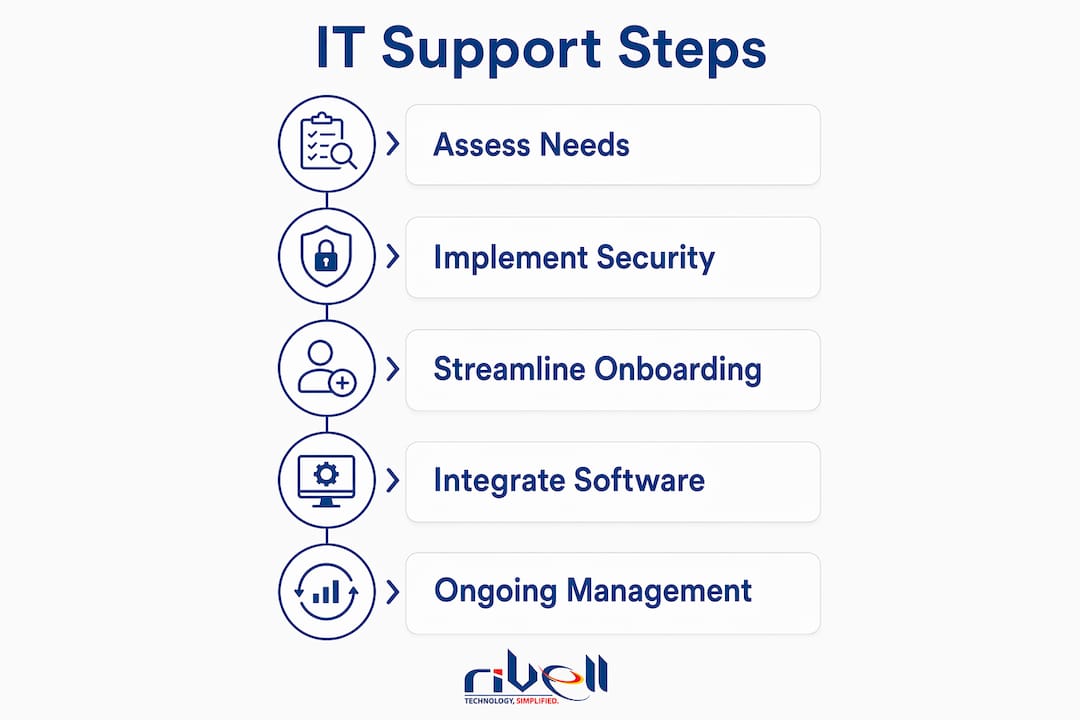
IT support for real estate firms can include system monitoring, help desk coverage, network management across office locations, cybersecurity controls, and coordination across MLS, property-management, and CRM platforms. A documented Tier 1, Tier 2, and Tier 3 support model helps route routine user requests, deeper technical faults, and vendor or engineering cases without losing ownership. Technology interruptions can delay document access, showings, communications, and time-sensitive transactions.
The core components of real estate IT support include:
- Continuous monitoring of networks, servers, and cloud environments to catch problems before agents notice them
- Help desk support for agents and staff, covering software issues, device problems, and access requests
- Cybersecurity protection including endpoint detection, email security, and compliance with the FTC Safeguards Rule
- Cloud and server management through platforms like Microsoft 365 and Azure
- Software integration connecting MLS platforms, property management systems, and CRMs
- Mobile device management for field agents working from phones and tablets
- Data backup and disaster recovery to protect transaction records and client files
Table of Contents
- What does IT support for real estate actually cover?
- How should real estate firms approach cybersecurity and compliance?
- Why does real estate software integration fail so often?
- Expert best practices for managing IT in real estate firms
- Key Takeaways
- Rivell brings real estate IT support under one roof
What does IT support for real estate actually cover?
Managed IT services for real estate firms operate on monthly contracts, replacing the old break-fix model where you called someone only after something broke. That shift matters because proactive managed services reduce vulnerability from agent mobility and client data exposure, while keeping technology costs predictable rather than unpredictable.
The specific services a real estate firm needs include managed IT services designed for real estate that cover continuous monitoring, help desk support, and network management.
- Managed help desk: 24/7 support for agents and office staff, covering password resets, software errors, VPN access, and device setup
- Network and Wi-Fi management: oversight of office connectivity and multi-site networks, including branch offices and remote locations
- Server and cloud management: administration of Microsoft 365, Azure, and on-premise servers including patching, updates, and performance monitoring
- Mobile device management (MDM): securing and managing the phones and tablets agents use in the field, including remote wipe capabilities if a device is lost
- IT asset tracking and automation: automated onboarding and offboarding workflows so new agents get access on day one and departing agents lose it immediately
- Disaster recovery and backup: automated, offsite backups of transaction records, contracts, and client data with tested recovery procedures
- Vendor coordination: managing relationships with MLS providers, property management software vendors, and telecom carriers so your team does not spend hours on hold
Real estate firms with high agent turnover benefit especially from automated onboarding and offboarding. When someone joins or leaves, IT infrastructure management handles account provisioning and deprovisioning without manual intervention from office managers.
How should real estate firms approach cybersecurity and compliance?
Wire fraud and ransomware are the leading cybersecurity threats in real estate, with compromised email accounts as the most common entry point. A single fraudulent wire instruction sent from a spoofed email address can redirect a closing payment to a criminal account. That is not a hypothetical scenario — it happens to firms of every size.
The security controls that actually reduce this risk:
- Multi-factor authentication (MFA) on all email accounts, especially Microsoft 365 and Google Workspace
- DMARC configuration to prevent domain spoofing and stop fraudulent emails from appearing to come from your firm
- Endpoint detection and response (EDR) on every device, including agent laptops and office workstations
- Anti-phishing training with simulated phishing tests so agents recognize social engineering attempts before they click
- Regular security audits to identify gaps before attackers do
- Written information security program (WISP) developed with legal input, covering risk assessments, employee training, and vendor management
The FTC Safeguards Rule requires brokerages handling mortgage transactions to maintain a formal written information security program, with civil penalties for non-compliance. The National Association of Realtors recommends working with an attorney licensed in your state to develop cybersecurity policies, breach response procedures, and data retention rules. State-specific data privacy laws add another layer — what applies in California differs from New Jersey.
Pro Tip: DMARC enforcement alone does not stop wire fraud. Pair it with a firm-wide policy requiring agents to verbally confirm any wiring instruction change by phone before acting on it, regardless of how legitimate the email looks.

Why does real estate software integration fail so often?

Integration challenges, not product features, are the most common reason real estate technology fails to scale. Firms buy tools expecting data to flow automatically between their MLS platform, property management system, and CRM. What they get instead is a patchwork of manual workarounds, stale data, and IT tickets.
The core problems:
- No system of record: when two systems both contain the same data, there is no established answer to which one is correct. Manual reconciliation consumes exactly the time the tools were supposed to save.
- API limitations: major property management platforms control API access in tiers, and deep integration requires dedicated engineering resources plus ongoing business partnerships, not just a developer and an afternoon.
- Inconsistent data models: Salesforce is built for leasing agents; a real estate ERP like Yardi is built for property accountants. Neither side maps cleanly to the other without custom objects and explicit hierarchy logic.
- Sync timing conflicts: real estate ERPs were not designed for sub-minute sync. The industry standard involves tiered synchronization: near real-time for critical events like signed leases, micro-batch syncs for standard updates, and nightly batch reconciliation for historical records.
- Workflow conflicts: tools often assume different process ownership, forcing teams to create workarounds rather than gaining efficiency.
Firms that expand their tool stacks without centralized data governance end up with more manual reconciliation work, not less. The fix is a vendor-independent system of record and governed data architecture controlled by the firm, not by any individual vendor.
Expert best practices for managing IT in real estate firms
The firms that get technology right share one habit: they treat integration as an ongoing operational function, not a one-time IT project. Here is what that looks like in practice:
- Establish a clear system of record before adding any new tool. Every data point needs one authoritative source. Two systems editing the same record is how data corruption starts.
- Adopt proactive managed IT rather than break-fix support. Reactive IT spending is unpredictable and leaves firms exposed between incidents. Monthly managed services convert that risk into a fixed, budgetable cost.
- Formalize integration rollouts with project timelines, executive sponsorship, and regular check-ins between internal teams and vendors. BXP’s CTO Jim Whalen scaled a technology deployment across 10 million square feet in five months by running structured biweekly calls with all parties focused on specific milestones.
- Monitor integrations automatically. A mature integration alerts your team promptly when a sync failure occurs. If your vendor’s answer to “how would we know if sync breaks?” is “your team would tell us,” that vendor is making you the monitoring system.
- Simplify before you add. The firms that win are not the ones with the most tools. They are the ones with fewer, well-governed systems where everyone knows which number is correct.
- Plan for staff turnover. Automated onboarding and offboarding workflows protect both security and continuity when agents join or leave.
Pro Tip: When evaluating any new real estate software vendor, ask them to define exactly what “integrates” means for their product. A logo on a partner page and a full bidirectional real-time sync are both called “integration.” Only one of them works the way you expect.
Key Takeaways
Specialized IT support for real estate firms requires proactive management, governed data architecture, and cybersecurity built around the industry’s specific threats, not generic business IT.
| Point | Details |
|---|---|
| Proactive beats reactive | Managed IT services replace unpredictable break-fix costs with fixed monthly budgets and continuous monitoring. |
| Email security is critical | Wire fraud enters through compromised email; MFA, DMARC, and anti-phishing training are the primary defenses. |
| Integration needs governance | A vendor-independent system of record prevents data conflicts that manual reconciliation cannot keep up with. |
| Compliance is mandatory | The FTC Safeguards Rule requires a formal written security program for brokerages handling mortgage transactions. |
| Rivell for real estate firms | Rivell provides managed IT services for New Jersey real estate firms, covering monitoring, cybersecurity, and cloud management under a single monthly contract. |
Rivell brings real estate IT support under one roof
Real estate firms in New Jersey deal with a specific combination of pressures: agents working from multiple locations, sensitive client financial data, MLS and property management software that needs to stay in sync, and compliance obligations that carry real penalties. Generic IT support does not account for any of that.
Rivell has spent over 25 years managing IT environments for businesses across New Jersey, including firms in regulated industries where uptime and data security are not optional. For real estate professionals, that means managed IT services covering continuous monitoring, help desk support, network management, Microsoft 365 administration, cybersecurity protection, and data backup, all under a predictable monthly contract. No waiting for something to break. No surprise invoices. Rivell takes full ownership of the technology environment so your agents can focus on closing deals. Contact Rivell to schedule a consultation and see what a purpose-built IT program looks like for your firm.