
Cyber attack recovery is the organized process of restoring your business’s systems, data, and operations safely and efficiently after a cybersecurity incident. For small and medium businesses, the stakes are high. Businesses with tested incident response plans experience breach costs 35% lower than unprepared organizations. That gap represents real money, real downtime, and real reputational damage. The NIST Cybersecurity Framework and CIRCIA’s 2026 reporting mandates have raised the bar further, making a documented, practiced recovery plan a business necessity, not a luxury.
What are the essential components of a cyber attack recovery plan?
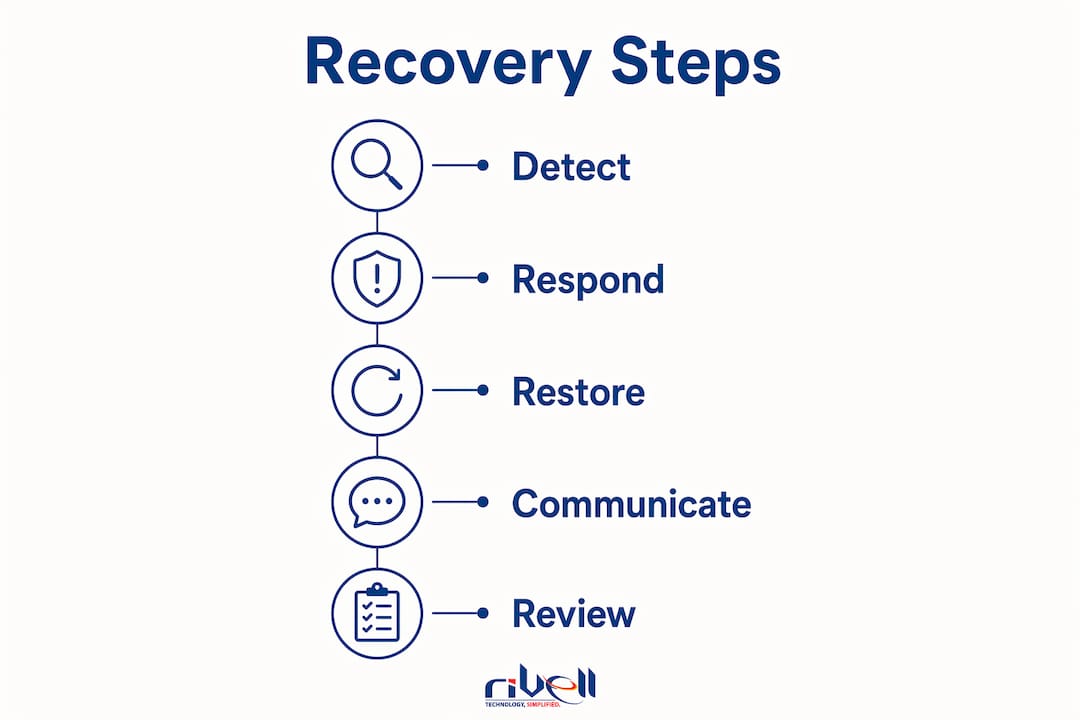
A recovery plan is only useful if it covers the right ground. The NIST Cybersecurity Framework organizes this into six core functions: detect, respond, contain, notify, recover, and learn. Each step depends on the one before it, so gaps in any phase extend your downtime and increase your costs.
Detection and initial response means your team knows exactly who to call and what to do in the first 30 minutes. This is not the time to improvise. A single page with names, phone numbers, and the first five actions your team must take is worth more than a 50-page policy document no one has read.

Prioritized restoration order focuses on business impact, not technical convenience. Identify which systems your business cannot operate without. Payroll, customer records, and order processing typically come before internal file shares or secondary applications.
Backup validation and restoration procedures must be documented and tested before you need them. Ransomware increasingly targets backup infrastructure, with over 90% of attacks now attempting to compromise backups. Knowing your backups are clean and restorable is not optional.
Communication templates save hours during a crisis. Prepare pre-written messages for employees, customers, vendors, and regulators. Under CIRCIA 2026 mandates, covered entities must report significant incidents to CISA within 72 hours and ransomware payments within 24 hours. Missing that window creates legal exposure on top of your technical problems.
Post-incident review closes the loop. After recovery, document what happened, what worked, and what failed. Update your plan accordingly. Recovery without learning is just waiting for the next incident.
Pro Tip: Keep a printed copy of your incident response plan in a physical location your team can access even when your network is down.
Which tools and practices help SMBs prepare for recovery?
Preparation is where most small businesses fall short. The tools and habits you build before an attack determine how fast you recover after one.
| Preparation Practice | Why It Matters |
|---|---|
| Annual tabletop exercises | Reduce mean response time by up to 40% and are increasingly required by cyber insurers |
| Encrypted offsite backups | Protect data from ransomware that targets on-site and cloud-connected backups |
| Pre-negotiated IR retainer | Gives you immediate access to forensic experts without scrambling during a crisis |
| Centralized logging and monitoring | Speeds up detection and provides the evidence trail needed for regulatory reporting |
| Documented recovery runbooks | Ensure any team member can execute recovery steps without relying on one person |
Tabletop exercises deserve special attention. A 90-minute session walking your team through a simulated ransomware attack reveals gaps in your plan that no amount of reading will uncover. A one-page plan practiced via a 90-minute tabletop consistently outperforms a bulky, unpracticed document. Simplicity and repetition beat complexity every time.
Offsite backups must be both encrypted and tested. Storing backups is not enough. You need to know the restoration process works, how long it takes, and whether the restored data is complete. Test a full restoration at least twice a year.
Pro Tip: Pre-negotiate a contract with an incident response firm before you need one. Rates and availability are far better when you are not calling in a panic at 2:00 AM.
What steps should SMBs take immediately after a cyber attack?
Speed matters, but sequence matters more. Recovery means restoring business functions safely and in order, not simply getting files back as fast as possible. Follow these steps in sequence.
Isolate affected systems. Disconnect compromised machines from the network immediately. Do not power them off. Shutting down a machine destroys volatile memory data, including encryption keys and attacker artifacts, that forensic investigators need.
Activate your incident response plan. Notify your designated incident response lead. If you have a managed IT provider or IR retainer, call them now. Document the time, the systems affected, and the first symptoms you observed.
Perform forensic imaging. Before cleaning or restoring anything, forensic imaging preserves evidence for root cause analysis. This step is non-negotiable if you need to report to regulators or file an insurance claim.
Contain and eradicate. Remove malware, close the attack vector, and patch the vulnerability that allowed entry. Do not skip this step before restoration. Restoring to an environment that still has the attacker present guarantees re-infection.
Verify backup integrity. Check that your backups predate the infection and have not been tampered with. Restoring from a compromised backup causes repeated re-infection, extending downtime and costs significantly.
Restore systems in prioritized sequence. Bring identity services online first, then core business applications, then supporting systems. Restoring all systems simultaneously causes network congestion and cascading failures that extend your outage.
Communicate status clearly. Update employees, customers, and any required regulators with factual, calm messaging. Silence breeds rumors and erodes trust faster than the attack itself.
“The businesses that recover fastest are not the ones with the most technology. They are the ones that practiced what to do before anything went wrong. A tested plan, even a simple one, cuts through the chaos that follows an attack.”
What common mistakes occur during cyber attack recovery?
Recovery errors are predictable. Knowing them in advance means you can avoid them under pressure.
Powering off affected machines. This destroys volatile forensic data, including active network connections and in-memory malware artifacts. Isolate from the network instead of shutting down.
Restoring from unverified backups. If your backup was already infected before you noticed the attack, restoring it reintroduces the threat. Always verify the backup date and run integrity checks before restoration.
Restarting all systems at once. Simultaneous restoration floods the network and causes failures that look like new attacks. Use a phased sequence: identity services first, critical apps second, everything else last.
Failing to document the incident. Poor documentation creates problems with cyber insurance claims, regulatory filings, and post-incident reviews. Log every action your team takes with timestamps from the moment you detect the attack.
Skipping post-recovery monitoring. Attackers often leave backdoors or secondary payloads. Heightened monitoring for at least 30 days after recovery catches re-entry attempts before they escalate. Review your network security practices to close gaps that the attack exposed.
SMBs without a documented recovery plan average about 22 days of downtime after ransomware. Prepared businesses recover significantly faster. That difference is almost entirely explained by avoiding the mistakes above.
How can SMBs build stronger cybersecurity readiness after recovery?
Recovery is the floor, not the ceiling. The period immediately after an attack is the best time to build habits that reduce the impact of the next one.
Update your incident response plan. Incorporate every lesson from the incident. What detection gap let the attacker in? What slowed your response? Fix those specific issues in writing.
Train your employees. Most breaches begin with a phishing email or a weak password. Regular cybersecurity awareness training for your team is the highest-return investment you can make in prevention.
Deploy endpoint detection and response tools. Basic antivirus is not enough. Endpoint detection and response (EDR) tools monitor behavior in real time and flag suspicious activity before it becomes a full breach.
Review and test your backups again. After a recovery event, verify that your backup systems were not compromised during the attack. Rebuild your backup schedule with the new threat in mind.
Document external response ownership. A managed IT provider can monitor, escalate, coordinate vendors, administer backups, or support recovery only to the extent written in the agreement. For New Jersey businesses, define which managed IT and disaster recovery responsibilities remain internal, then use the IT support provider evaluation guide to compare escalation, security, backup, contract, and transition terms.
The goal is cyber resilience: the ability to absorb an attack and return to normal operations quickly. Resilience is built through repeated practice, updated plans, and the right partners.
Key Takeaways
Effective cyber attack recovery requires a tested incident response plan, verified backups, and a sequenced restoration process that prioritizes critical systems before anything else.
| Point | Details |
|---|---|
| Test your plan before you need it | Annual tabletop exercises cut mean response time by up to 40% and satisfy cyber insurer requirements. |
| Sequence your restoration | Restore identity services first, then core apps, to prevent network crashes and cascading failures. |
| Verify backups before restoring | Over 90% of ransomware attacks target backups; always confirm cleanliness before restoration. |
| Document everything | Timestamped incident logs support insurance claims, regulatory filings, and post-incident reviews. |
| Build resilience after recovery | Update your plan, train your team, and deploy EDR tools to reduce the impact of future incidents. |
Why most SMBs underestimate recovery until it’s too late
I have worked with enough small business owners to know that recovery planning almost always gets pushed to next quarter. There is always something more urgent. A new hire, a product launch, a client deadline. Recovery planning feels abstract until the moment it is not.
What I have seen consistently is that the businesses that recover well are not the ones with the biggest IT budgets. They are the ones that ran a single tabletop exercise and wrote down who calls whom. That is it. One afternoon of preparation separates a three-day recovery from a three-week nightmare.
The other thing I want to say plainly: recovery is a business continuity problem, not just a technology problem. When your systems go down, your employees cannot work, your customers cannot reach you, and your revenue stops. Every hour of downtime has a dollar value. Treating recovery planning as a line item on the IT checklist misses the point entirely.
SMBs actually have an advantage here. You can make decisions fast. You can run a tabletop with your whole team in one room. You can update your plan the same week you find a gap. Large enterprises spend months getting approvals for changes that you can implement by Friday. Use that speed.
Invest in recovery planning the same way you invest in insurance. You hope you never need it. But when you do, you will be very glad you did not skip it.
— Ryan
How Rivell supports SMBs through cyber incident recovery
Recovering from a cyber attack is faster and less costly when you have expert support already in place before the incident occurs.

Rivell provides New Jersey businesses with 24/7 monitoring, rapid threat detection, and managed IT services for small businesses that include incident response planning, backup management, and verified recovery support. Rivell’s team helps you build and practice your incident response plan, maintain clean and tested backups, and meet 2026 compliance requirements including CIRCIA reporting timelines. With over 25 years of experience supporting businesses in healthcare, professional services, and beyond, Rivell takes full ownership of your IT environment so you can focus on running your business. Contact Rivell to build a recovery-ready IT environment before you need one.
FAQ
What is cyber attack recovery?
Cyber attack recovery is the process of restoring a business’s systems, data, and operations after a cybersecurity incident. It includes containment, eradication, verified restoration, and post-incident review.
How long does it take to recover from a ransomware attack?
SMBs without a documented recovery plan average about 22 days of downtime after ransomware. Businesses with tested incident response plans recover significantly faster.
What should I do first after discovering a cyber attack?
Isolate affected systems from the network without powering them off, then activate your incident response plan and contact your IT provider or incident response retainer immediately.
Why should I not restore from backup immediately after an attack?
Over 90% of ransomware attacks target backup infrastructure. Restoring from a compromised backup reintroduces the threat and extends downtime. Always verify backup integrity and confirm the backup predates the infection before restoring.
Does my small business need to report a cyber attack to regulators?
Under CIRCIA 2026 mandates, covered entities must report significant cyber incidents to CISA within 72 hours and ransomware payments within 24 hours. Consult legal counsel to determine whether your business qualifies as a covered entity.