
This website uses cookies to improve your experience. We'll assume you're ok with this, but you can opt-out if you wish. Read More
Reviewed: August 17, 2026. This page uses current Avigilon and Motorola Solutions product material plus CISA screening guidance. Product availability, dimensions, integration requirements, subscriptions, software compatibility, and support terms should be confirmed against the current manufacturer documentation and proposal before procurement.
Rivell’s role is to connect product selection with facility conditions, infrastructure, operating procedures, training, testing, documentation, and ongoing technical support.
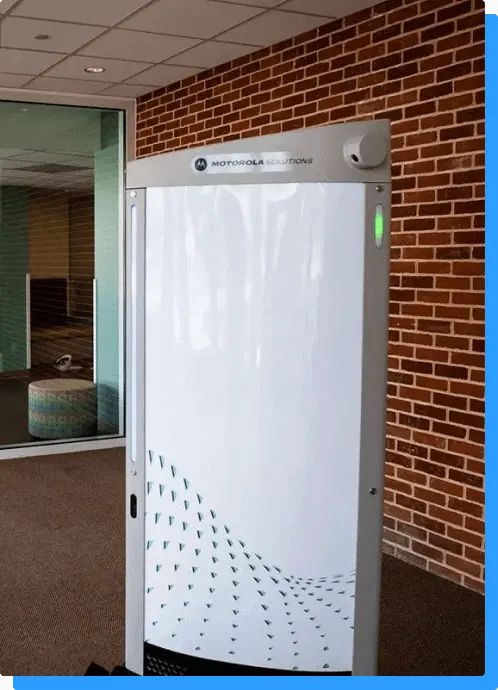
Motorola Solutions Concealed Weapons Detection, powered by Evolv Technology, is a walk-through screening system that uses sensors and software to flag potential concealed weapons or threats for operator review. The current Avigilon product page describes indoor and outdoor configurations, adjustable sensitivity settings, potential-threat location indicators, integrated Avigilon cameras, and Avigilon Unity Video workflows.
A system alert is not a final determination. The current manufacturer data sheet describes routing an alerted person to secondary screening for further investigation. The operating plan therefore needs trained people, a clear decision process, a private and respectful follow-up location, escalation criteria, and a documented response when an item is confirmed, cleared, or cannot be resolved.
Define what the organization is trying to screen, at which entrances, during which hours or events, and under whose authority. Record the prohibited-items policy, expected visitors, peak arrival pattern, employee and contractor procedures, accessible-route needs, delivery and bag policies, emergency exits, bypass risks, and how screened and unscreened populations remain separated.
CISA’s facility access control guidance treats screening as an integrated process. It calls for trained personnel, written initial and follow-up procedures, documented testing and calibration, and operator interpretation of security technology. Those controls matter as much as the equipment selected.
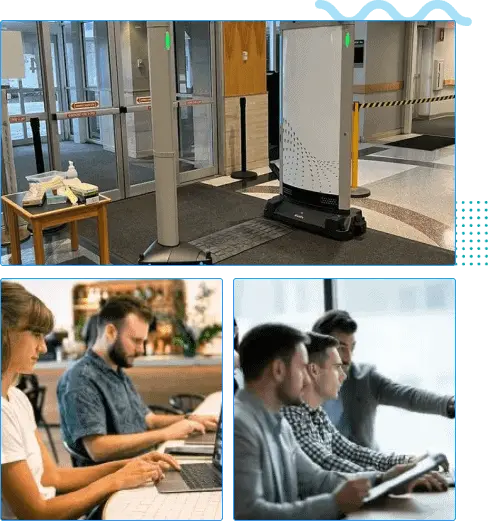
A Rivell site survey documents usable entrance width, queue and egress space, indoor or outdoor conditions, floor and mat requirements, power, network paths, mounting limits, lighting, camera views, operator sightlines, secondary-screening space, storage, and the route for law enforcement or emergency response. Temporary-event use and permanent daily screening may require different layouts and staffing.
Model ordinary traffic and peak arrival periods. Identify where a queue could block an exit, expose unscreened side entrances, affect accessibility, or create a new congregation point. Confirm that signage and pre-arrival communications explain the prohibited-items and bag policies. The final layout should support the written workflow instead of forcing operators to invent a process after installation.
The workflow should define who watches the alert display, who directs a person to secondary screening, who conducts follow-up screening, when a supervisor is called, when law enforcement is contacted, and how the organization handles refusals or exceptions. Use role-based access for any connected video or management software. Keep the process consistent, respectful, and aligned with counsel, policy, civil-rights, privacy, labor, and accessibility requirements that apply to the facility.
CISA’s Public Venue Security Screening Guide covers patron communication, bag searches, handheld detectors, physical searches, staffing, training, and checkpoint operations. A technology alert should connect to an approved secondary-screening procedure, not replace it.
Concealed weapon detection may be one control in a broader physical-security program. Depending on the approved design, related systems may include video surveillance, access control, commercial alarms, emergency communications, and visitor management. Integration scope must identify what event is exchanged, who receives it, what video is shown or recorded, and what happens when an integration or network path is unavailable.
Review Rivell’s guide to concealed weapon detection technology and limitations and its discussion of concealed weapon detection in schools for additional planning context. Facility leadership, security personnel, counsel, law enforcement, and relevant community stakeholders should review the operating model before launch.
Create a responsibility matrix for policy approval, site access, installation, network changes, system administration, operator staffing, secondary screening, law-enforcement coordination, privacy requests, incident records, maintenance, support, and change control. Record which tasks belong to Rivell, the manufacturer, the facility, the security team, and other vendors.
Validate power, network ports, addressing, DNS, time synchronization, firewall rules, software and camera connectivity, administrative accounts, update ownership, logging, remote-support access, and backup of relevant configurations. Rivell’s network design service can map connectivity and failure paths, while its cybersecurity service can review accounts, permissions, remote access, logging, and device-management responsibilities.
Training should cover system start-up and shutdown, normal passage, alert interpretation, sensitivity selection, lane management, accessibility accommodations, secondary screening, prohibited items, exceptions, de-escalation, emergency communications, evidence handling, privacy, incident documentation, and equipment faults. Use hands-on scenarios and test each role rather than relying only on a demonstration.
Run a controlled pilot using representative entrances, lighting, traffic, bags, personal items, staffing, and environmental conditions. Record alerts, cleared items, unresolved events, queue behavior, operator actions, communications, and any bypass path. Adjust the approved configuration and procedures only through documented change control.
Set schedules for functional checks, manufacturer-recommended inspection or calibration, software and firmware review, account review, operator refresher training, scenario exercises, incident review, configuration review, and support escalation testing. Track failures and corrective actions. Reassess the design when entrances, traffic, policies, threats, staffing, integrations, or facility use changes.
| Decision area | Required evidence | Approval owner |
|---|---|---|
| Security objective | Threat and prohibited-items scope, operating hours, entrances, exceptions, and legal or policy authority | Facility leadership and security |
| Site and traffic | Survey, dimensions, power, network, queue model, accessible route, egress review, and bypass controls | Facilities and project owner |
| Screening workflow | Operator roles, secondary screening, refusals, exceptions, escalation, law-enforcement contact, and fallback procedures | Security operations |
| Privacy and records | Notice, access, retention, deletion, video use, incident records, and response to data requests | Counsel and privacy owner |
| Acceptance | Authorized scenarios, expected results, observed results, open defects, corrective actions, and approval signatures | Project and security owners |
| Lifecycle support | Inspection, configuration, updates, accounts, training, testing, vendor escalation, spare equipment, and change-control schedule | Named service owner |





This website uses cookies to improve your experience. We'll assume you're ok with this, but you can opt-out if you wish. Read More
Preferences

concealed weapons detection, wifi concealed weapons detection device, contactless weapons detection
concealed weapons detection, wifi concealed weapons detection device, contactless weapons detection