
A multi-cloud management platform centralizes some visibility, governance, cost, and automation functions across public and private cloud environments. When workloads span AWS, Azure, and Google Cloud, provider consoles, billing models, identity constructs, and policy controls differ. Use Rivell’s cloud service provider comparison to document provider and workload fit before selecting a cross-cloud control plane. This guide covers what CMPs do, how to evaluate them, where they fit in the tool stack, and how to stage a rollout.
What is a multi cloud management platform?
A multi cloud management platform centralizes visibility, governance, and automation across multiple cloud environments through a single interface. The industry term is “cloud management platform,” or CMP. The phrase “multi cloud management” describes the use case: applying that control plane across more than one provider or environment type. Both terms are in active use, and understanding the distinction helps you evaluate vendors accurately.
CMPs address a real operational problem. Managing multiple clouds increases complexity in identity and access management (IAM), networking, and security. Standardizing workflows through a CMP is the primary way IT teams avoid the kind of repetitive manual work that slows incident response and creates compliance risk. Frameworks like PCI DSS and HIPAA require consistent policy enforcement across every environment where regulated data lives. A CMP makes that enforcement practical at scale.

The core value is not just visibility. It is the ability to act on what you see. A CMP that shows you idle resources but cannot trigger automated remediation is a dashboard, not a management platform.
What core features define effective cloud management platforms?
The most capable CMPs share a specific set of features. Knowing what to expect helps you separate genuine platforms from glorified dashboards.
- Single-pane-of-glass dashboard. Centralized dashboards that filter by business unit, application, or environment improve incident response and budgeting efficiency. A dashboard showing raw cloud objects without context limits your team during outages and budget reviews.
- Policy-as-code enforcement. Governance-as-Code, using frameworks like Open Policy Agent (OPA), enables continuous automated scanning against policies and triggers automatic remediation for misconfigurations. This replaces periodic manual audits with real-time compliance.
- FinOps reporting and rightsizing. Integrated cost monitoring identifies idle resources and recommends rightsizing. Organizations achieve meaningful savings by eliminating waste through unified visibility rather than cutting capacity across the board.
- Automated lifecycle management. Automated workflows for provisioning, policy-based orchestration, and event-driven remediation reduce manual effort and operational errors. Consistency across environments improves reliability and accelerates delivery.
- Security posture management. Continuous compliance scanning against PCI DSS, HIPAA, and similar frameworks keeps your security posture current without requiring a dedicated audit cycle.
- Hybrid and private cloud support. The best multi cloud solutions cover on-premises infrastructure and private clouds, not just public providers. If your environment includes VMware or bare-metal servers, verify that support depth before committing.
Pro Tip: Test the dashboard with your actual cloud account structure before signing a contract. A demo environment rarely reflects the complexity of real-world tagging hierarchies and multi-account setups.
How do you choose the right cloud management platform?
Selecting a CMP is a multi-year commitment. Total cost of ownership must include hidden expenses such as professional services, custom connector development, and ongoing maintenance beyond license fees. Evaluate on these criteria in order of operational impact:
- On-premises and private cloud depth. Public cloud coverage is table stakes. What differentiates platforms is how well they handle on-premises workloads and private environments. Shallow support here creates a management gap that forces your team back to manual processes for a significant portion of your infrastructure.
- API-first architecture. A platform built around APIs integrates cleanly into CI/CD pipelines and infrastructure-as-code (IaC) workflows. Platforms that bolt on API access as an afterthought create friction every time you try to automate a new workflow.
- Policy propagation reliability. Policies must reach remote and intermittently connected sites consistently. A platform that drops policy updates when a site goes offline creates compliance gaps that are difficult to detect and expensive to remediate.
- Control plane data residency. Where your management plane stores data matters for GDPR, HIPAA, and other regulatory frameworks. Confirm that the vendor’s data residency options match your compliance requirements before evaluation goes further.
- Integration with existing tools. Key selection criteria include how well a CMP connects with your observability stack, security posture tools, and ticketing systems. A platform that requires you to replace your existing monitoring tools adds hidden switching costs.
- Agentless architecture. Agentless CMP architectures reduce complexity and maintenance overhead compared to agent-installed alternatives. In 2026, agentless is the preferred deployment model because it eliminates the operational burden of managing agents across thousands of virtual machines.
How do CMPs fit into a hybrid cloud management stack?
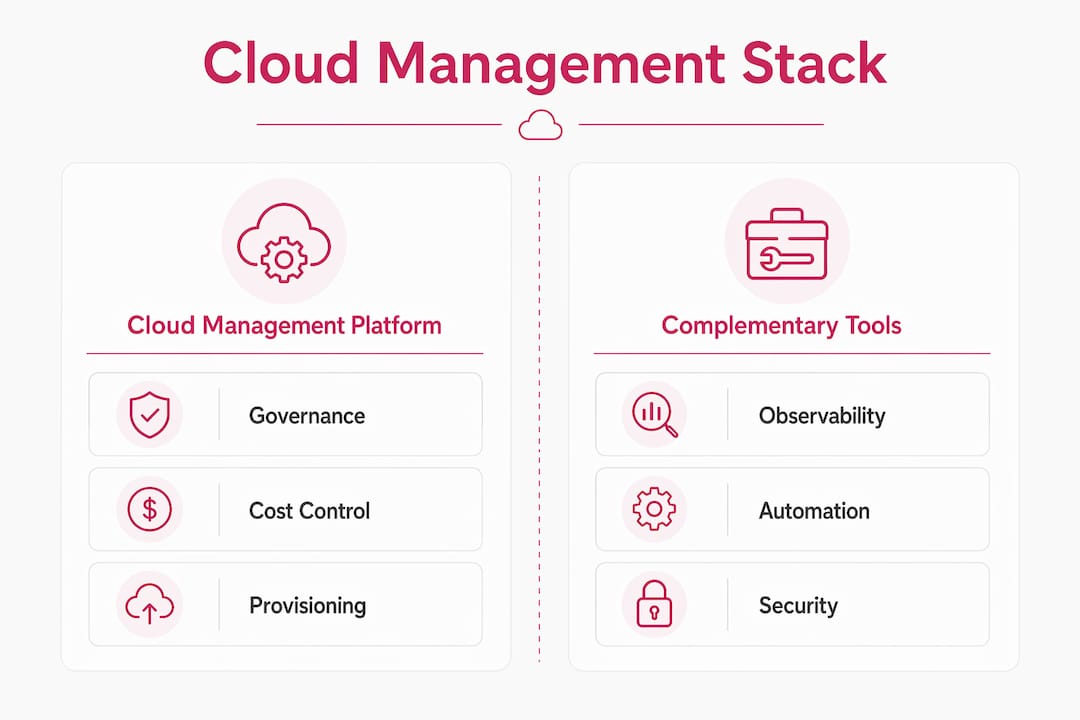
No single platform covers all cloud management needs equally. Hybrid cloud environments benefit from multiple specialized tools working together rather than one platform trying to do everything. Understanding where a CMP fits prevents both over-reliance and under-utilization.
| Tool category | Primary function | How it complements a CMP |
|---|---|---|
| Cloud management platform | Governance, provisioning, cost, automation | Core control plane across all environments |
| Observability platform | Unified monitoring, alerting, tracing | Provides performance context the CMP lacks |
| Infrastructure-as-code tools | Declarative, repeatable provisioning | Feeds the CMP’s automation workflows |
| Security posture management | Continuous vulnerability and config scanning | Extends CMP policy enforcement with deeper analysis |
| Kubernetes fleet management | Container workload orchestration | Manages workloads the CMP provisions but does not schedule |
The CMP governs and provisions. The observability platform tells you what is happening inside those workloads. IaC tools like Terraform or Pulumi define the desired state that the CMP enforces. Trying to force one tool to do all of this well is a common and costly mistake. A phased approach works better: start with the CMP for governance and cost, then connect observability and IaC tools as your team matures.
What are the best practices for adopting cloud management tools?
Adoption strategy determines whether a CMP delivers value or becomes shelfware. Phased rollout starting with visibility and cost management delivers immediate return on investment and reduces implementation risk. Attempting to implement all capabilities simultaneously is a frequent cause of project failure.
- Start with visibility and cost. Get your unified dashboard working and your cost data flowing first. This delivers fast ROI and gives your team confidence in the platform before you add complexity.
- Add policy enforcement progressively. Once your team understands the environment through the dashboard, layer in policy-as-code enforcement. Start with tagging policies and access controls before moving to automated remediation.
- Prioritize agentless deployment. Agentless platforms simplify multi-cloud management by reducing resource overhead on managed virtual machines. This matters most in large environments where agent maintenance becomes a full-time job.
- Standardize governance from day one. Enforce consistent tagging, naming conventions, and access policies across every environment the CMP manages. Retrofitting governance onto an untagged environment is significantly harder than building it in from the start.
- Automate compliance drift detection. Configure the platform to alert on and remediate compliance drift continuously. Manual audit cycles miss configuration changes that happen between reviews.
- Balance power with usability. A platform your team finds too complex will not get used. Adoption requires that the interface makes daily tasks faster, not slower.
Pro Tip: Run a 30-day cost visibility pilot before committing to full deployment. The savings identified in that window often justify the platform cost and build internal support for broader rollout.
How do CMPs drive business value and reduce operational risk?
The business case for a cloud orchestration platform rests on three measurable outcomes: faster incident response, lower compliance risk, and reduced cloud spend.
Centralized visibility reduces incident response times and operational overhead by eliminating manual reconciliation across siloed cloud consoles. When an outage hits, your team needs one place to look, not five separate provider consoles. A unified view cuts the time from detection to diagnosis significantly.
Automated policy enforcement reduces compliance risk under frameworks like PCI DSS and HIPAA. Manual compliance processes depend on human consistency. Governance-as-Code removes that dependency by scanning continuously and remediating automatically. The result is a compliance posture that does not degrade between audit cycles.
Vendor lock-in is a real commercial risk. A CMP that abstracts workloads across providers gives your organization genuine negotiating leverage at contract renewal time. Without that abstraction, switching costs make it nearly impossible to credibly threaten to move workloads.
Cost optimization through idle resource identification and rightsizing addresses one of the largest sources of cloud waste. The savings come from visibility, not from cutting capacity indiscriminately. Teams that can see exactly what is running and what it costs make better decisions than teams working from monthly billing reports alone. You can learn more about how centralized reporting tools deliver cost savings in complex IT environments.
Key Takeaways
A multi cloud management platform delivers maximum value when deployed in phases, integrated with complementary tools, and governed by policy-as-code from the start.
| Point | Details |
|---|---|
| Start with visibility | Deploy cost and resource dashboards first to deliver fast ROI before adding automation. |
| Use agentless architecture | Agentless CMPs reduce maintenance overhead and simplify deployment across large environments. |
| Evaluate total cost of ownership | Factor in professional services, custom connectors, and maintenance beyond the license fee. |
| Integrate, do not replace | Pair your CMP with observability and IaC tools rather than expecting one platform to do everything. |
| Enforce governance from day one | Standardize tagging and access policies at rollout to avoid costly retrofitting later. |
What I’ve learned from watching CMP rollouts succeed and fail
The most common mistake I see IT managers make is buying a CMP based on feature count. A platform that checks every box in a vendor demo often fails in production because the integration work required to connect it to existing tools was never scoped. The license fee is the smallest part of what you will spend.
The second mistake is treating a CMP as a destination rather than a foundation. The teams that get the most out of these platforms are the ones that treat the CMP as the governance layer and build their observability, IaC, and security tooling around it deliberately. They do not expect the CMP to replace Terraform or their monitoring stack. They expect it to coordinate those tools.
Agentless platforms have a real advantage in large environments. I have seen agent-based deployments where the maintenance burden of keeping agents current across thousands of VMs consumed more engineering time than the platform saved. If you are evaluating platforms, agentless architecture should be a hard requirement, not a preference.
Finally, usability matters more than most procurement processes acknowledge. If your team finds the platform confusing, they will route around it. The best cloud management tools are the ones your engineers actually open every morning.
— Ryan
How Rivell supports multi cloud and hybrid cloud environments
Managing a multi cloud environment without dedicated expertise creates risk that compounds over time. Rivell provides managed IT services that cover cloud operations, security, and compliance monitoring across hybrid and multi-cloud architectures.
Rivell’s team handles continuous monitoring, policy enforcement, and cost management so your internal staff can focus on delivering business outcomes rather than managing infrastructure. With over 25 years of experience and deep expertise in compliance frameworks including HIPAA and PCI DSS, Rivell takes full ownership of your IT environment. Explore the benefits of managed IT services and see how a managed approach reduces operational risk while improving cloud efficiency across your organization.
FAQ
What is a multi cloud management platform?
A multi cloud management platform is software that provides centralized visibility, governance, and automation across multiple cloud providers through a single control plane. It supports cost management, policy enforcement, and compliance across public and private environments.
How does a CMP differ from a cloud orchestration platform?
A CMP covers governance, cost, and provisioning across cloud environments, while a cloud orchestration platform focuses specifically on automating and coordinating workflows between services. In practice, mature CMPs include orchestration capabilities as one component of a broader feature set.
What is the best way to start managing multi cloud environments?
Start with a visibility and cost management deployment before adding policy enforcement or automation. A phased rollout reduces implementation risk and delivers measurable ROI quickly, which builds internal support for broader adoption.
Why is agentless architecture important in a cloud management platform?
Agentless CMPs eliminate the need to install and maintain software agents on managed virtual machines. This reduces resource overhead and maintenance complexity, which matters significantly in environments with thousands of workloads.
How do hybrid cloud management solutions differ from pure multi cloud tools?
Hybrid cloud management solutions extend CMP capabilities to on-premises and private cloud infrastructure, not just public providers. The key differentiator is depth of on-premises support, including policy propagation and visibility for workloads that never touch a public cloud.