
Which managed IT support providers in New Jersey stand out?
The three providers New Jersey SMBs and mid-sized companies evaluate most often are DigaCore, ICS (Integrated Computer Services), and CorpTech. Each covers the core managed services nj businesses need, but they differ meaningfully on cybersecurity depth, industry focus, and cloud capabilities.
| Provider | DigaCore | ICS (Integrated Computer Services) | CorpTech |
|---|---|---|---|
| Best for | SMBs needing proactive cybersecurity and full IT management | Mid-sized businesses in regulated industries | Businesses prioritizing cloud integration and fast local response |
| Services offered | Monitoring, help desk, cybersecurity, backup, compliance | Network management, cybersecurity, compliance, help desk | Cloud services, help desk, backup, network support |
| 24/7 monitoring and support | Yes | Yes | Yes |
| Cybersecurity capabilities | Firewall, threat detection, compliance support | Deep cybersecurity, industry certifications | Endpoint protection, cloud security |
| Industry expertise | Healthcare, legal, finance | Healthcare, legal, finance, manufacturing | General business, cloud-heavy verticals |
| Local presence and responsiveness | Strong NJ presence | Strong NJ presence | Strong NJ presence |
| Customer ratings/reputation | Well-regarded by NJ SMBs | High customer satisfaction | Positive local reputation |
DigaCore suits owners who want a single provider to own the entire IT environment, from daily monitoring to compliance documentation. ICS brings the deepest regulatory credentials, making it the natural fit for law firms, medical practices, and financial services companies that face strict audit requirements. CorpTech is the clearest choice when cloud migration or a Microsoft 365 overhaul is the immediate priority.

What core services do managed IT providers deliver to New Jersey businesses?
A managed service provider (MSP) takes over the day-to-day IT work your internal team either cannot cover or should not be spending time on. The service stack a credible New Jersey MSP offers typically includes:
- Proactive system monitoring and 24/7 help desk support: Continuous network and server surveillance with live technicians available around the clock for tickets and escalations.
- Cybersecurity management: Firewall configuration, malware protection, threat detection, and endpoint protection covering every device on your network. Notably, only 57% of MSPs provide managed network security, so verifying this capability before signing is worth the extra conversation.
- Cloud services and Microsoft 365 administration: Migration planning, license management, SharePoint configuration, and ongoing cloud environment oversight.
- Data backup and disaster recovery: Automated daily backups with tested restore procedures and documented recovery time objectives.
- IT consulting and infrastructure planning: Roadmaps aligned to your growth plans, hardware refresh cycles, and budget forecasting.
- Remote and on-site technical support: Most issues resolve remotely within minutes; on-site dispatch covers hardware failures and physical installations.
The breadth of that list matters because gaps in coverage create gaps in protection. An MSP that handles monitoring but outsources backup, for example, leaves you with split accountability when something goes wrong.
How do compliance and cybersecurity requirements affect New Jersey businesses?

New Jersey law requires any business that owns or licenses personal data about state residents to implement a written information security program covering administrative, technical, and physical safeguards. That program must include firewall protection, regular security patches, malware defenses, and contractual requirements on any third-party service provider handling that data.
For SMBs, the financial exposure from getting this wrong goes beyond regulatory fines. The average ransomware-related downtime cost for a small or mid-sized business is $141,000, a figure that reflects lost productivity, recovery labor, and reputational damage combined.
Key compliance and cybersecurity elements a qualified MSP addresses:
- Administrative safeguards: Designated security personnel, employee training, and documented incident response plans.
- Technical safeguards: Multi-factor authentication, encrypted data transmission, intrusion detection, and patch management.
- Physical safeguards: Controlled server room access, device tracking, and secure disposal of hardware.
- Third-party oversight: Contracts requiring vendors and cloud providers to meet the same security standards your business must meet under New Jersey statute.
- Ongoing risk assessments: Regular vulnerability scans and penetration testing to catch gaps before attackers do.
A security assessment before onboarding an MSP gives you a baseline and makes the compliance conversation far more productive from day one.
Which industries do New Jersey MSPs specialize in?
New Jersey MSPs concentrate heavily on regulated verticals, because those industries face the steepest penalties for IT failures and the most complex compliance requirements.
- Healthcare: HIPAA-compliant infrastructure, electronic health record (EHR) system support, and business associate agreement management.
- Legal: Secure client data handling, matter management system integration, and e-discovery readiness.
- Financial services: SOX and GLBA compliance support, encrypted communications, and audit trail documentation.
- Manufacturing: Operational technology (OT) network segmentation, supply chain system integration, and uptime protection for production environments.
- Professional services: General compliance support, Microsoft 365 governance, and scalable infrastructure for growing firms.
The practical difference between a generalist MSP and one with genuine vertical experience shows up during an audit or an incident. A provider that has walked a medical practice through a HIPAA audit knows exactly which documentation to pull and which controls to demonstrate. That institutional knowledge is not something you can replicate by reading a checklist.
Why does choosing a local New Jersey MSP matter?
Geography still matters in managed IT, even with remote monitoring tools covering most day-to-day work.
- Faster on-site response: When a server fails or a network switch goes down, a local technician can be on-site in hours rather than days.
- Regulatory familiarity: New Jersey-based providers track state-specific data protection statutes and local compliance trends as part of their standard practice.
- Established local references: A provider with years of New Jersey clients can connect you with references in your own industry and region, not just national case studies.
- Business continuity during regional events: A local MSP with New Jersey infrastructure is better positioned to support you through weather events or regional outages that affect the area.
- Community accountability: Providers with a local reputation have more at stake in every engagement. Word travels fast in a regional business community.
Managed IT services in New Jersey from a provider who knows the state’s regulatory environment and can dispatch a technician the same day is a materially different product from remote-only support delivered from another state.
How do you choose the right managed IT partner in New Jersey?
The best MSP for your business is the one that starts by asking about your business goals, not by pitching its service catalog. Top-tier MSPs begin every engagement by understanding what drives your revenue, where your risk tolerance sits, and what a bad IT day actually costs you.
Use this checklist when evaluating providers:
- Assess service breadth: Confirm the provider covers monitoring, cybersecurity, backup, cloud, and help desk under one contract, not through subcontractors.
- Verify cybersecurity capabilities: Ask specifically which security services are included and which cost extra. Request documentation of their own security posture.
- Review SLA terms: Look for defined response times, escalation paths, and remedies if those commitments are missed.
- Demand pricing transparency: Fixed monthly fees with clearly listed add-ons are far easier to budget around than variable billing.
- Check local references: Ask for two or three New Jersey clients in your industry you can call directly.
- Identify red flags: Vague contracts, no dedicated account manager, resistance to providing references, and pricing that seems too low to cover 24/7 support are all warning signs.
Pro Tip: Prioritize a long-term partnership over the lowest monthly rate. An MSP that cuts corners on cybersecurity to win on price will cost you far more when a breach or outage hits.
What does onboarding with a managed IT provider look like?
A well-run onboarding process takes four to six weeks and follows a predictable sequence. The provider audits your existing infrastructure, documents every device, application, and user account, then installs monitoring agents and security tools. After that baseline is set, they migrate any services being transferred and train your staff on new helpdesk procedures.
The transition period is where most problems surface, so ask any prospective provider how they handle the first 90 days specifically. Providers who assign a dedicated onboarding engineer and schedule weekly check-in calls during that window tend to produce far smoother transitions than those who hand you off to a general support queue immediately after signing.
What pricing models do managed IT providers use?
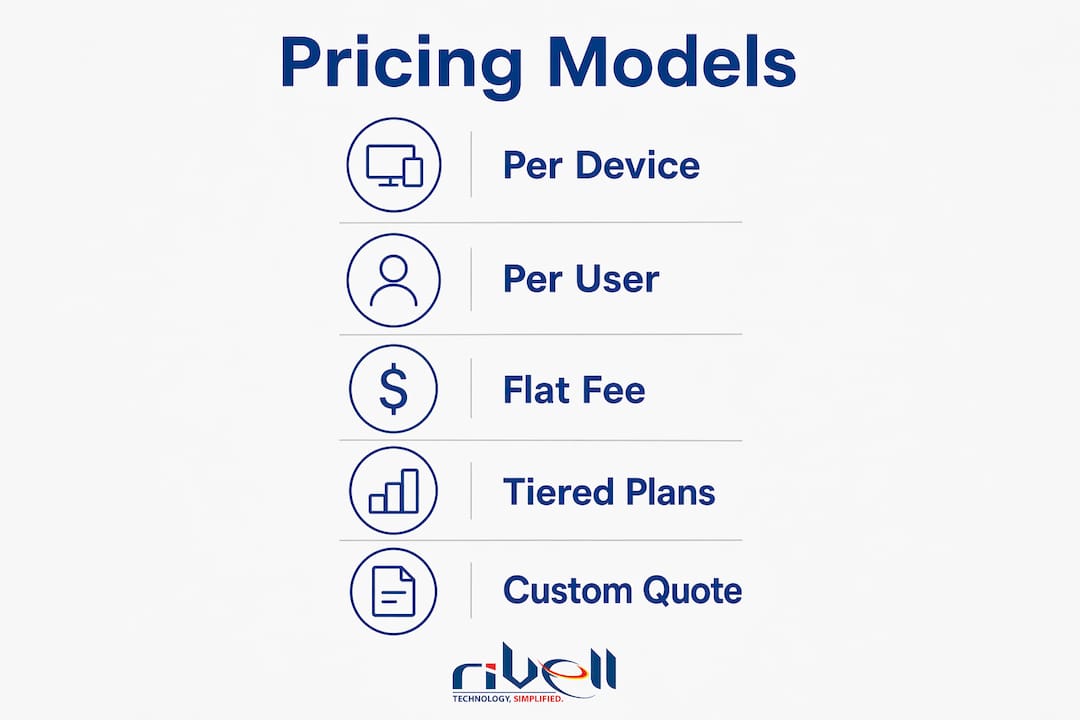
Most New Jersey MSPs price on a per-device or per-user monthly flat fee, which makes budgeting straightforward. Some offer tiered plans where basic monitoring sits at a lower rate and full cybersecurity management sits at a higher one. Project work, such as a server migration or a new office buildout, is typically billed separately at an hourly or fixed-project rate.
Managed IT services pricing consistently runs below the fully loaded cost of an equivalent in-house IT hire when you factor in salary, benefits, training, and after-hours coverage. The flat-fee model also converts unpredictable IT spending into a fixed line item, which most finance teams prefer.
What should an SLA with a managed IT provider guarantee?
A service level agreement (SLA) is the document that converts a provider’s verbal promises into contractual obligations. At minimum, a credible SLA specifies response time by ticket severity (critical, high, medium, low), uptime targets for monitored systems, escalation procedures when the first-line technician cannot resolve an issue, and remedies if the provider misses its commitments.
Watch for SLAs that define “response” as acknowledgment of a ticket rather than active work on the problem. Those two things are not the same. An SLA that promises a four-hour response but allows unlimited resolution time offers very little protection during an outage.
What do New Jersey businesses say about their managed IT providers?
Local case studies carry more weight than national testimonials because they reflect the specific regulatory environment, business culture, and infrastructure challenges New Jersey companies actually face. When evaluating a provider, ask for written case studies or direct references from New Jersey clients in your sector. A healthcare practice in Morris County and a law firm in Camden County face different IT realities, and a provider with documented experience in both is demonstrably more prepared than one citing generic success stories.
Providers who cannot produce local references or who redirect every reference request to a national client list are telling you something about their depth in the New Jersey market.
Rivell offers a different approach to managed IT in New Jersey
Rivell brings over 25 years of experience managing IT environments for New Jersey businesses, with a model built around full ownership of your IT infrastructure so your team never has to context-switch between vendors.
Where DigaCore, ICS, and CorpTech each excel in specific niches, Rivell’s value is breadth without the complexity: one provider covering network management, server oversight, cybersecurity, Microsoft 365, cloud management, data backup, disaster recovery, and VoIP under a single monthly agreement. For New Jersey SMBs and mid-sized companies in healthcare, legal, or professional services that need compliance-ready IT without building an internal department, Rivell’s managed IT services for small businesses are worth a direct conversation. The engagement starts with your business goals, not a product pitch.
Key Takeaways
The strongest managed IT support in New Jersey combines 24/7 monitoring, verified cybersecurity capabilities, and local expertise in New Jersey compliance requirements, not just the lowest monthly price.
| Point | Details |
|---|---|
| Ransomware cost exposure | Le coût moyen des interruptions liées à un ransomware pour une PME s’élève à 141 000 $, ce qui souligne l’importance de mesures de sécurité proactives. |
| Cybersecurity coverage gap | Only 57% of MSPs provide managed network security; always verify this before signing. |
| Compliance obligation | New Jersey law requires a written information security program with administrative, technical, and physical safeguards. |
| SLA specificity matters | Demand response times by severity level and defined remedies, not just ticket acknowledgment windows. |
| Rivell for NJ businesses | Rivell covers the full IT stack under one agreement, with 25+ years serving New Jersey SMBs and regulated industries. |