
Cloud-based identity and access management solutions are the control plane for who gets into your systems, what they can do once inside, and how quickly you can revoke that access when something goes wrong. For a New Jersey business running distributed teams, Microsoft 365, and a mix of cloud and on-premises apps, the practical next step is straightforward: inventory your identities, enable phishing-resistant MFA today, and schedule a managed-service assessment to scope a pilot. Here is what you need to know to move from decision to deployment.
At a glance:
- Core functions: authentication (SSO, MFA), authorization (RBAC/ABAC), identity lifecycle management, privileged access control, and machine identity governance
- Business benefit: converts capital IT spend to predictable monthly costs, cuts helpdesk password tickets, and automates onboarding and offboarding
- Immediate next step: contact Rivell for a managed IAM assessment or pilot scoped to your NJ environment
Table of Contents
- What are cloud-based identity and access management solutions?
- Why cloud IAM makes financial and operational sense for NJ businesses
- What U.S. cybersecurity guidance says you should do first
- Platform vs. managed service: which approach fits your environment?
- How to implement cloud IAM: a step-by-step checklist
- Why New Jersey businesses should consider a managed IAM partner
- Key Takeaways
- The case for taking IAM seriously now
- Rivell’s managed cloud IAM services for New Jersey businesses
- Useful sources
What are cloud-based identity and access management solutions?
Cloud IAM is the control plane for authentication and authorization across every cloud resource your organization uses. It decides, in real time, whether a given identity — a person, a service account, or an API key — is allowed to reach a specific resource and what it can do there.
The core components break down like this:
- Identity establishment: creating and managing digital identities for employees, contractors, and non-human entities
- Authentication: verifying identity through SSO and MFA before granting access
- Authorization: enforcing what an authenticated identity can actually do, using RBAC, ABAC, or policy-based access control (PBAC)
- Lifecycle management: automated provisioning when someone joins, role changes when they move, and instant deprovisioning when they leave
- Privileged access management (PAM): controlling and auditing elevated permissions for administrators and sensitive systems
- Machine identities: governing service accounts, API keys, and AI agents with the same rigor as human users
Cloud IAM design depends on the provider’s identity model, federation support, logging, privileged-access controls, and the customer’s configuration responsibilities. Before standardizing an IAM pattern, use Rivell’s cloud service provider comparison to document which platform owns each workload and control boundary. Standards such as SAML, OIDC, and FIDO2 can support federation and stronger authentication, but implementation details vary by platform, tenant, and application.
Why cloud IAM makes financial and operational sense for NJ businesses
Cloud IAM converts upfront capital expenditure into predictable monthly costs, and that shift alone changes how most small and midsize businesses budget for security. No hardware to rack, no upgrade cycles to fund, and no dedicated IAM engineering team required to keep the lights on.
The operational gains are just as concrete. Automated lifecycle management means a new hire has the right access on day one and a departing employee loses it the moment HR closes the record. SSO reduces the number of passwords users manage, which directly cuts helpdesk password-reset volume. Centralized audit logs make compliance evidence collection a reporting task rather than a fire drill.

For NJ businesses in healthcare or professional services, the compliance angle matters most. HIPAA requires documented access controls and audit trails. SOC 2 auditors want evidence of access reviews and least-privilege enforcement. Cloud IAM generates that evidence automatically, rather than requiring someone to manually compile it before each audit.
Cost and timeline framing: a scoped pilot typically runs several weeks and covers a single application or user group. Phased rollout across your environment takes a few months. Full governance, including access reviews and privileged access controls, reaches steady state in longer-term operation. What drives cost upward: the number of identities, the volume of app integrations, privileged access tooling requirements, and the extent of non-human identity governance needed.
What U.S. cybersecurity guidance says you should do first
CISA and NSA guidance is direct: phishing-resistant MFA, least privilege, just-in-time access for privileged actions, and no long-term static credentials for machine-to-machine authentication. These four controls address the majority of identity-based breaches. Here is a prioritized checklist aligned to that guidance:
- Enable phishing-resistant MFA for all user accounts, starting with administrators and remote-access users. Hardware keys (FIDO2) or certificate-based authentication are the gold standard.
- Apply least privilege to every role. Grant only the permissions needed for a specific function. Audit and tighten assignments quarterly.
- Implement just-in-time (JIT) access for privileged tasks. Administrators request temporary elevated permissions for a defined window rather than holding standing admin rights.
- Eliminate long-lived static credentials for service accounts and APIs. Replace them with short-lived tokens and automated rotation.
- Activate continuous monitoring and configure alerts for anomalous login behavior, geographic outliers, and privilege escalation attempts.
- Enforce conditional access policies that evaluate device posture, location, and risk signals before granting access, not just at login.
- Audit identity federation configurations regularly to detect trust-relationship abuse.
NIST SP 800-207 frames identity as the new security perimeter under Zero Trust: every access request must be continuously validated using context like device posture and user behavior, not just a one-time login check.
Pro Tip: Treat machine identities — service accounts, API keys, CI/CD pipeline credentials — as first-class citizens in your IAM program. They often outnumber human accounts and carry excessive privileges that go unreviewed for months. Enforce short-lived credentials and rotation policies from day one.
For HIPAA-covered NJ businesses, controls 1, 2, and 5 map directly to the Technical Safeguards requirement. SOC 2 Type II auditors will specifically look for evidence of MFA enforcement, access reviews, and audit log retention.
Platform vs. managed service: which approach fits your environment?
For most NJ SMBs without a dedicated IAM engineer, a managed-service approach reduces risk and accelerates time to value. Platform-only deployments suit organizations with deep internal expertise and the capacity to own policy design, integration work, and ongoing governance.
The major cloud IAM platforms each fit different environments:
- Microsoft Entra (Azure AD): the natural choice for Microsoft-centric shops running Microsoft 365 and Azure. Deep conditional access, seamless SSO across Microsoft apps, and strong hybrid integration via Entra Connect.
- Okta: strong in multi-cloud and heterogeneous environments. Broad pre-built connector library and mature lifecycle automation make it well-suited for organizations with diverse SaaS stacks.
- Google Cloud Identity: fits Google Workspace-primary environments and organizations already invested in Google Cloud Platform. Solid for developer teams running GCP workloads.
- Auth0 (by Okta): developer-first platform for organizations building customer-facing or API-driven applications that need flexible authentication flows.
| Dimension | SaaS platform (self-managed) | MSP-managed IAM |
|---|---|---|
| Best for | Organizations with internal IAM expertise | SMBs without dedicated IAM staff |
| Deployment model | Customer-configured SaaS | Fully managed, MSP-owned configuration |
| Core features | SSO, MFA, RBAC, provisioning, PAM | Same, plus policy design, monitoring, reviews |
| Microsoft 365 integration | Native (Entra) or via connector | Configured and maintained by MSP |
| Pricing shape | Per-user/per-feature subscription | Monthly managed-service fee |
| Compliance support | Customer-built reporting | MSP-delivered audit evidence and reporting |
| Ongoing support | Vendor support tiers | Dedicated helpdesk, SLA, incident response |
Pro Tip: If your organization runs Microsoft 365, start with Microsoft Entra before evaluating additional platforms. You likely already have licenses that include conditional access and MFA capabilities you are not yet using.
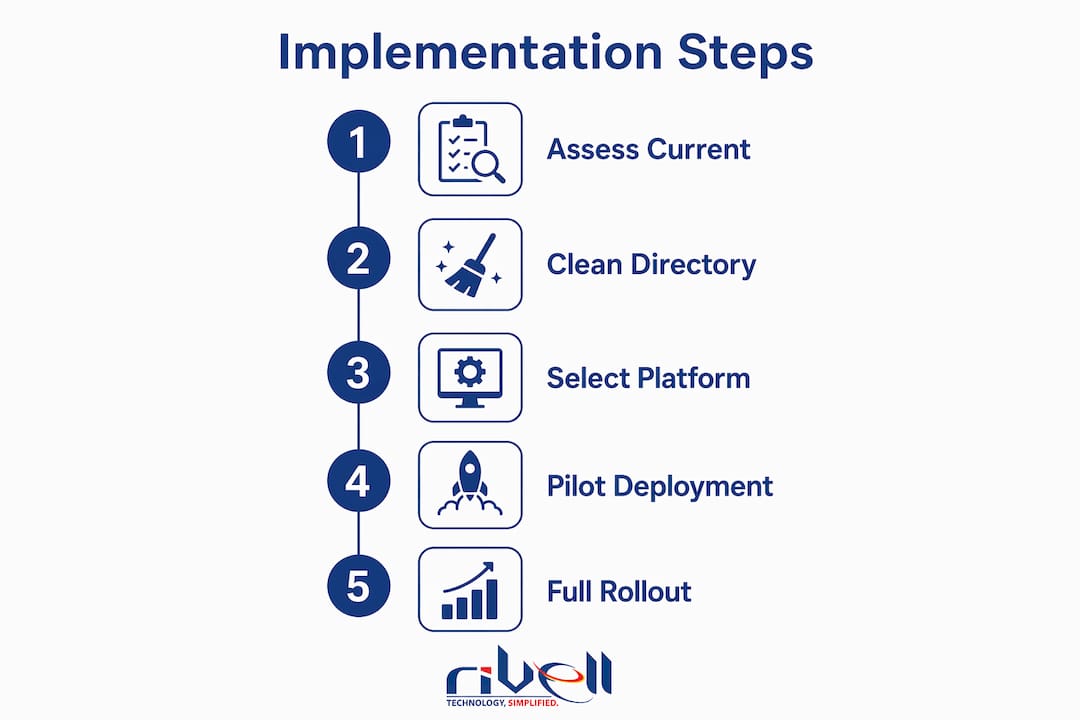
How to implement cloud IAM: a step-by-step checklist
Start with a scoped pilot, clean your identity data, then roll out in waves. Trying to migrate everything at once is the fastest route to orphaned accounts and policy gaps.
- Assessment (Week 1–2): Audit your current identity sources, app inventory, and existing access policies. Identify gaps, stale accounts, and over-privileged roles.
- Identity inventory and cleanup (Week 2–3): Sanitize on-premises directories before syncing to the cloud. Stale accounts and service entries replicate into your new environment and immediately become a liability.
- Policy design (Week 3–4): Define least-privilege roles, group structures, and conditional access rules. Document the logic before you configure it.
- Integration (Week 4–6): Connect priority applications. Start with your highest-risk or most-used apps.
- Pilot (Week 4–6): Deploy to a controlled user group. Validate SSO, MFA flows, and provisioning automation before broader rollout.
- Phased migration (Week 6–12): Roll out by department or application group. Maintain rollback capability.
- Access reviews (Month 3+): Schedule quarterly reviews of role assignments, privileged access, and non-human identity permissions.
- Continuous monitoring (Ongoing): Activate audit logging, anomaly detection, and automated alerts from day one of production.
Pro Tip: Before you sync anything to the cloud, run a deduplication and stale-account sweep on your Active Directory. A directory with five years of accumulated service accounts and departed employees will replicate every one of those risks into your new IAM environment.
For cost planning: the main drivers are the number of app connectors required, whether you need dedicated PAM tooling, the degree of automation in lifecycle workflows, and how many non-human identities require governance. A phased cloud migration approach keeps each cost driver visible and controllable.
Why New Jersey businesses should consider a managed IAM partner
Managed IAM offloads the specialized configuration, policy engineering, and ongoing governance work that most NJ SMBs do not have the internal bandwidth to own. The time-to-value is shorter, the risk of misconfiguration is lower, and you get local, responsive support rather than a vendor ticket queue.
A full-scope managed IAM engagement typically covers:
- Identity consolidation and directory cleanup
- MFA and SSO deployment across priority applications
- Least-privilege policy design and RBAC configuration
- Privileged access management and JIT implementation
- Continuous monitoring and anomaly alerting
- Quarterly access reviews and compliance reporting
- Incident response integration
When evaluating a managed IAM provider, request these trust signals before signing anything:
- SOC 2 Type II or ISO 27001 attestation
- References from NJ-based clients in your industry
- A written SLA covering response times and escalation paths
- A clear implementation timeline with defined milestones
- Transparent pricing tied to identity count and service scope
Rivell brings over 25 years of managed IT experience serving New Jersey businesses across healthcare, law, and professional services. The team takes full ownership of your IAM environment, from initial assessment through ongoing governance, so your internal staff focuses on the business rather than identity policy maintenance.
Key Takeaways
Cloud IAM requires phishing-resistant MFA, least-privilege enforcement, JIT for privileged access, and continuous monitoring to meaningfully reduce identity risk for New Jersey businesses.
| Point | Details |
|---|---|
| Start with MFA immediately | Enable phishing-resistant MFA for all admins and remote users before any other IAM project. |
| Clean your directory first | Sanitize on-premises identity sources before cloud sync to prevent replicating stale accounts and excess permissions. |
| Pilot before full rollout | A 2–4 week scoped pilot limits risk and validates SSO, MFA, and provisioning before broader deployment. |
| Machine identities need governance | Service accounts and API keys carry excessive privileges; enforce short-lived credentials and rotation from day one. |
| Rivell manages the full lifecycle | Rivell handles assessment, policy design, MFA/SSO deployment, and ongoing access reviews for NJ businesses. |
The case for taking IAM seriously now
Most articles about cloud IAM spend their energy explaining what it is. The harder question is why so many organizations that understand it still delay acting on it.
The honest answer is that IAM feels like infrastructure work: invisible when it is running well, catastrophic when it fails. That asymmetry makes it easy to defer. But the threat environment has shifted. Identity-based attacks are now the primary entry point for breaches, not network perimeter exploits. Phishing-resistant MFA and least-privilege enforcement are not advanced security measures anymore. They are the baseline.
What I see consistently with NJ businesses is that the gap is not knowledge — it is execution capacity. The IT team knows MFA should be on. They know that service account from 2019 probably has too many permissions. They just do not have the cycles to fix it systematically while keeping everything else running. That is exactly the problem a managed partner solves.
The organizations that treat IAM as a business enabler rather than a compliance checkbox get something else out of it: faster onboarding, fewer helpdesk calls, and audit prep that takes hours instead of weeks. That is a real operational return, not just a security posture improvement.
Rivell’s managed cloud IAM services for New Jersey businesses
New Jersey businesses that need cloud IAM done right, without hiring a dedicated identity engineer, have a direct path forward with Rivell. With 25+ years of managed IT experience across NJ healthcare, law, and professional services firms, Rivell takes full ownership of your IAM environment from day one.
The engagement starts with a no-obligation assessment: Rivell maps your current identities, flags your highest-risk gaps, and scopes a pilot you can approve and launch within weeks. From there, the team handles MFA and SSO deployment, least-privilege policy design, privileged access controls, and ongoing access reviews, all under a clear SLA.
Ready to stop deferring? Request a managed IAM assessment or explore Rivell’s full cybersecurity solutions for NJ businesses.
Useful sources
- CISA/NSA: Use Secure Cloud Identity and Access Management Practices — authoritative U.S. government guidance on cloud IAM best practices, MFA, JIT, and privilege controls
- NIST SP 800-207: Zero Trust Architecture — foundational Zero Trust framework positioning identity as the primary security perimeter
- CISA Cloud Security Guidance — CISA’s broader cloud security resource library covering identity, access, and configuration
- idmanagement.gov: Cloud IAM Playbook — federal implementation playbook covering directory cleanup, federation architecture, and phased deployment
- Cloudflare: What is IAM? — clear technical primer on IAM components and the control-plane model
- Okta: Cloud Identity and Access Management — vendor documentation covering IAM components, SSO, lifecycle automation, and deployment considerations
- RSA: Why Enterprises Need Cloud IAM — whitepaper on CapEx-to-OpEx shift, standards support (SAML, OIDC, FIDO), and managed deployment benefits
- Microsoft Learn: Azure Identity Management Best Practices — Microsoft’s official guidance on Entra ID, conditional access, RBAC, and hybrid identity
- Cloud Computing Authority: Cloud IAM Reference — implementation lifecycle reference covering inventory, federation, MFA, JIT, and continuous posture assessment