
Cloud based endpoint management solutions are centralized platforms that let IT teams monitor, patch, configure, and secure every organizational device from the cloud, without requiring on-site infrastructure. For small to mid-sized organizations, this shift from manual, on-premises device tracking to cloud-native control is no longer optional. Delayed patching concerns affect 44% of sysadmins, and 69% worry about single points of failure in IT knowledge. Those numbers reflect a real operational gap that cloud-based endpoint management directly addresses.
What are cloud based endpoint management solutions and how do they work?
Cloud based endpoint management solutions deliver device control through a lightweight agent installed on each endpoint, laptops, desktops, servers, and mobile devices, reporting back to a cloud-hosted management console. The IT manager sees every device in a single dashboard, regardless of where that device sits physically. No VPN tunnel required. No on-premises server to maintain.
The core workflow follows a predictable pattern. Devices enroll through the agent, populate an inventory automatically, and then receive policies for patching, configuration, and compliance. Remote troubleshooting happens through the same console, so a technician in New Jersey can fix a device in a remote office without dispatching anyone.

| Feature category | What it does | Why it matters for SMBs |
|---|---|---|
| Automated patch management | Deploys OS and application patches on a schedule | Closes vulnerabilities before attackers exploit them |
| Device inventory | Tracks hardware specs, software, and OS versions | Eliminates shadow IT and unknown devices |
| Remote access and control | Lets admins troubleshoot endpoints without being on-site | Cuts resolution time for distributed teams |
| Configuration enforcement | Pushes and maintains security baselines across all devices | Reduces configuration drift and compliance risk |
| Compliance monitoring | Flags devices that fall outside policy | Supports audit readiness without manual checks |
Cloud-native agent tools maintain device communication regardless of network environment, which means a remote employee on a home network stays fully managed. That VPN independence is a structural advantage over legacy on-premises systems.
Pro Tip: Deploy the agent through your existing software distribution method or a startup script during device imaging. Getting the agent on every device at provisioning time is far easier than chasing down unmanaged endpoints later.
What are the benefits of cloud-based endpoint management for SMBs?
The most direct benefit is time. A single sysadmin can manage several hundred devices using automated cloud-native tools, a workload that would require a much larger team with manual processes. That efficiency gain translates directly into cost savings for lean IT departments.
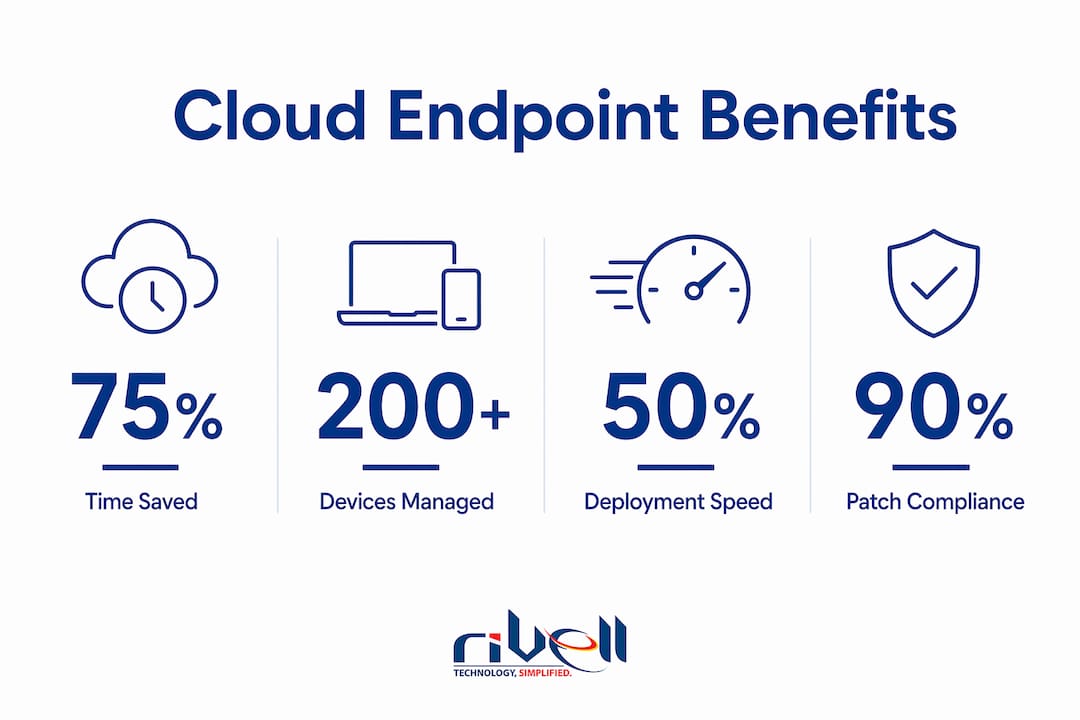
Security posture improves because patch compliance becomes measurable and enforceable. Instead of hoping that devices updated themselves, IT managers can see exactly which endpoints are current and which are exposed. Centralized visibility also surfaces unauthorized software and misconfigured devices before they become incidents.
The top five operational benefits for small to mid-sized organizations are:
- Faster patch deployment. Automated scheduling eliminates the manual patching cycle that leaves devices exposed for days or weeks.
- Full device visibility. Every endpoint appears in one inventory, including remote and hybrid workforce devices.
- Reduced human error. Policy enforcement replaces manual configuration, cutting the risk of inconsistent setups.
- Lower infrastructure cost. No on-premises management servers means no hardware refresh cycles or server licensing overhead.
- Support for hybrid work. Continuous monitoring and policy enforcement apply equally to office and remote devices.
Deployment speed is another underrated advantage. Transitioning to a cloud-native management platform can compress rollout from weeks to just days. For a growing organization adding headcount quickly, that speed matters.
Pro Tip: Set up automated patch reports to run weekly and send them directly to your IT leadership. Visibility at the leadership level creates accountability and makes it easier to justify the investment in endpoint management software.
How do endpoint management and endpoint security work together?
Endpoint management and endpoint security are distinct disciplines that work best when integrated. Endpoint management focuses on device health and compliance; endpoint security, specifically Endpoint Detection and Response (EDR) and Extended Detection and Response (XDR), concentrates on threat detection and neutralizing active attacks. Confusing the two leads to gaps in both operations and defense.
The practical difference shows up in ownership and outcomes. Management tools tell you whether a device is patched, enrolled, and configured correctly. Security tools tell you whether something malicious is running on that device right now. You need both answers.
| Dimension | Endpoint management | Endpoint security (EDR/XDR) |
|---|---|---|
| Primary focus | Device health, compliance, configuration | Threat detection, investigation, response |
| Key actions | Patching, inventory, remote access | Alerting, isolation, forensic analysis |
| IT ownership | IT operations team | Security team or managed security provider |
| Core outcome | Reduce attack surface | Detect and neutralize active threats |
Integration between these two layers produces the biggest operational payoff. Integrating endpoint management consoles with security tools reduces tool sprawl and context switching, enabling IT teams to handle performance and security alerts together. A practical example: a security alert for an unpatched vulnerability automatically triggers a patch deployment from the management console, closing the gap without a separate ticket or manual intervention.
For SMBs, this integration also reduces the number of separate tools IT managers must monitor daily. Fewer consoles mean faster response and less chance that a critical alert gets buried. Rivell’s approach to proactive endpoint protection reflects exactly this philosophy, combining management and security visibility into a unified operational picture.
What are best practices for deploying cloud-based endpoint management in SMB environments?
Phased deployment is the most reliable approach for SMBs. Start with a pilot group of 20 to 30 devices, validate that the agent installs cleanly, policies apply correctly, and reporting works as expected. Then expand to the full device fleet. Rushing a full rollout without a pilot phase creates troubleshooting noise that overwhelms lean IT teams.
Patch scheduling deserves careful planning. Staged rollouts, where patches deploy to a test group first and then roll out broadly after a validation window, prevent a bad update from taking down production systems. Most cloud-native endpoint management platforms support staged ring deployments natively. Use them.
The following practices reduce risk and improve outcomes in SMB deployments:
- Automate patch policies from day one. Manual patching is the fastest path to compliance gaps. Set policies at enrollment and let automation handle the rest.
- Build offboarding into your deployment plan. Device offboarding with remote wipe is critical to preventing data breaches when employees leave. Define the process before you need it.
- Separate corporate and personal data on BYOD devices. Remote wipe on a personal device must target only corporate data. Failing to configure this distinction creates legal and privacy exposure.
- Avoid VPN dependency. Modern cloud endpoint management tools maintain device communication without a VPN, which is the correct architecture for hybrid workforces.
- Start with a minimum viable stack. Lean IT teams benefit most from automated patching, device visibility, and remote access. Add ITSM or advanced MDM features only when the organization’s complexity demands them.
Pro Tip: Treat your endpoint management platform as the source of truth for device inventory. Sync it with your HR system so that when an employee is offboarded in HR, a workflow automatically triggers device wipe and license reclamation. That connection eliminates the most common offboarding failure point.
For SMBs managing a mix of Windows, macOS, and mobile devices, a cloud-native agent that handles all platforms from a single console is worth prioritizing over specialized tools that require separate management workflows. The managed services in the cloud model extends this logic further, offloading the operational burden entirely to a provider with the expertise to run these platforms at scale.
Key Takeaways
Cloud based endpoint management solutions give SMBs centralized control over device health, patch compliance, and security posture without requiring on-premises infrastructure or large IT teams.
| Point | Details |
|---|---|
| Agent-based architecture | Lightweight agents report to a cloud console, eliminating VPN dependency for remote devices. |
| Patch automation is non-negotiable | Automated, staged patch deployment closes vulnerabilities faster than any manual process. |
| Management and security must integrate | Connecting EDR tools with management consoles reduces tool sprawl and accelerates threat response. |
| Offboarding requires a defined process | Remote wipe and data separation for BYOD devices must be configured before the first employee departure. |
| Start lean, then scale | SMBs should prioritize patching, inventory, and remote access before adding complex ITSM or MDM layers. |
Why I think most SMBs overcomplicate this
The most common mistake I see in SMB endpoint management deployments is buying for a future state that never arrives. An organization with 80 devices purchases an enterprise platform built for 10,000 endpoints, then spends six months configuring features they will never use while their actual patch compliance sits at 60%.
The right approach is the opposite. AI-driven automation now handles pattern identification and conversational querying, freeing lean IT teams from repetitive tasks. But that technology only helps if the foundational layer, agent deployment, patch policies, and offboarding workflows, is already solid. Automation on top of a broken process just breaks faster.
The SMBs I have seen succeed with cloud endpoint management share one trait: they treat it as an operations discipline, not a product purchase. They assign ownership, review compliance reports weekly, and update policies as the organization changes. The platform is almost secondary to the process.
Emerging identity-based access controls are worth watching. The next wave of endpoint management integrates device compliance status directly into access decisions, so a device that fails a patch check loses network access automatically. That is a meaningful security improvement for organizations that cannot afford a dedicated security team. Evaluate tools with that integration path in mind, even if you are not ready to deploy it today.
— Ryan
How Rivell helps SMBs manage endpoints without the complexity
Managing endpoints across a growing device fleet is a full-time operational responsibility. For many small to mid-sized organizations, that responsibility competes with every other IT priority on the list.
Rivell provides managed IT services for small businesses that include proactive endpoint monitoring, patch management, and device security, handled by an experienced team so your internal staff can focus on business priorities. With over 25 years of experience serving New Jersey organizations across healthcare, professional services, and beyond, Rivell takes full ownership of the IT environment. Organizations looking for a broader view of what this model delivers can review the benefits of managed IT services to understand how the investment compares to managing endpoints in-house.
FAQ
What is cloud based endpoint management?
Cloud based endpoint management is a centralized IT discipline that uses cloud-hosted consoles and lightweight device agents to monitor, patch, configure, and secure organizational endpoints remotely. It eliminates the need for on-premises management infrastructure.
How many devices justify a cloud endpoint management platform?
Most small businesses need formal endpoint management once their device count exceeds about 25 or when remote work is integrated, because manual tracking becomes unsustainable at that scale.
What is the difference between endpoint management and endpoint security?
Endpoint management handles device health, patching, and configuration; endpoint security tools like EDR focus on detecting and responding to active threats. Both are necessary, and integrating them reduces gaps in protection.
Do cloud endpoint management tools require a VPN?
Modern cloud-native endpoint management platforms do not require a VPN. Agent-based tools maintain device communication across any network environment, which makes them well-suited for hybrid and remote workforces.
How does cloud based patch management reduce security risk?
Automated software update and patch management can deploy operating-system and application updates on defined schedules. Staged rollout groups and verification checks help teams detect compatibility problems before a wider deployment.